Digital DJ Tips3>

Learn How To DJ With Digital DJ Gear

Why DJing Is Like Sex (Or, When To Play Your Best Tunes…)

DJ set planning

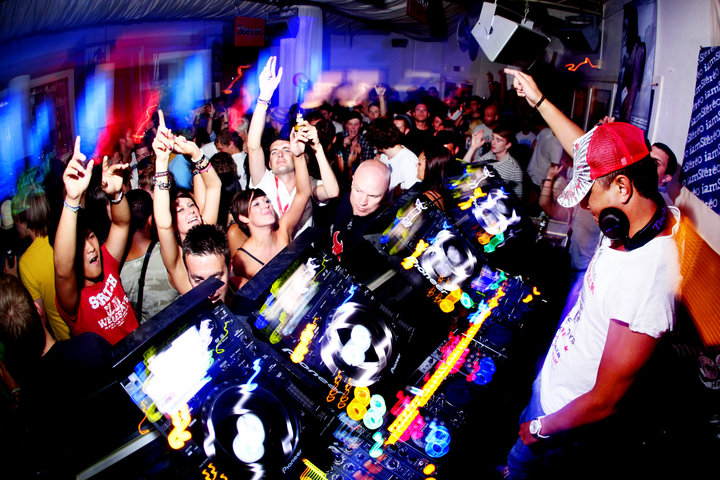
Knowing when to drop your peak-time floorfillers is an important part of successful DJing. Pic: Rob Wilder

One of the thoughts that usually races through a DJ’s mind at a certain point when playing an important set is: “What do I do about playing my best tunes? Do I start with them now, or is it still too early?” Knowing exactly the right moment to unleash musical fury onto the dancefloor (or foot-tapping, sing-along music in a cocktail bar) requires a combination of intuition and experience, and is something that can separate a good DJ from an average one.

That’s why I always tell people on the floor who come and request a peak time track at the very start of the night that DJing is much like having sex! You should never release the energy too fast at the start of the act…


No, the job is to shape and build up the energy, tease, build some more, wait until exactly the right time and only then pull out all your, ahem, banging tracks that make the whole dancefloor bounce up and down, whooping in excitement. People can literally be running from the bar to the floor to hear your set at that point!

Peaking too soon
Putting on your best dance tracks at the start can leave you feeling depleted by the end of your set, having run out of energy-boosting tunes. People will leave with the memory of few people dancing, you looking lost in your booth and the promoter or owner shaking his head.

The feeling of having run out of decent dancing tunes to play with an hour left of your set is not a good one…

Rarely should a DJ puts on his on her peak dance tracks at the beginning. The only exceptions are places where you’ll need to arrive and play your top tunes earlier than normal such as bars and clubs where people are already in the mood as soon as you arrive (typically, for pub and bar DJs right after a raucous happy hour full of groups of friends), or if you start your set late.

In all other cases, you’ll build to the boiling point only after first warming the crowd, shaping your set and waiting for the right time to release the beast.

The feeling of having run out of decent dancing tunes to play with an hour left of your set is not a good one. The last thing you want to give people is an anti-climax just before they leave.

Busy dancefloor

This is no time to be carrying on playing your deep house warm-up material...

Peaking too late
On the other hand, the problem when peaking too late is that you may never really get the dancefloor going. People might even leave the venue before you get warmed up. Many DJs who fall into this trap do so because they’re worried they won’t have enough tunes to last them through a long set.

If this is you, what you may find is that once you play a decent tune that people enjoy, seeing them enjoy themselves gets you more into the atmosphere and you’ll start pulling out tracks you’d never have thought of playing five minutes before, because you’re relaxing and enjoying yourself and getting a whole load of new ideas from their reactions. Seeing people dancing is infectious and should bring out the best in you.

How to do it

OK, we’ve established there is an optimal time for peaking during a night and it’s not always the same time, as it depends upon the venue, the people and the atmosphere on the night. So how do you do it?

This is the safe zone, between half and two-thirds of the way through the night.

Well, if you’re the main DJ that night, your place is full and you are wondering what to do, a good rule of thumb is to start peaking just after half-way through your set. This is the safe zone, between half and two-thirds of the way through the night. You should have enough tunes to keep mixing at high, energetic tempo until about 15 minutes before the end, when you’ll be looking at wrapping up with more emotional closing tracks.

If you’re confident you’ve prepared your tracks well, then you’ll have enough good tunes to fuel you through a long two or three hour set of people dancing, and you’ll hopefully be able to keep them jumping around until the end.


The trick is to be open and flexible about this and not use it as an unchanging rule. You make the rules on your night. Obviously if the place is almost empty, you won’t slam out your hottest tracks and dance away on your own in your booth if no-one else is in your bar or club just because it’s halfway through the night! Wait at least until there are people who want to enjoy themselves there. (At least in an empty club you’ll spot them when they arrive… ;) )

Keeping them there…
Another task is what to do once you’ve got them there. I like to create “waves”: play four, five or six stomping tracks in a row, then slow it down slightly with a more emotional track of a different style that will send some clubbers away from the floor but bring others onto it.

A track or two later you can build up again to create to another climatic dramatic sequence of dancefloor fillers and get people going crazy once more. Repeat and rinse this process until you’re near to the end of your set.

My five tips for perfect timing…

  1. Avoid releasing your beasts and secret dancefloor weapons too early or you’ll have none left at the end (unless you’re in a place where you start late)
  2. If you don’t know when to boost the tempo, then consider starting to peak your set in the safe zone, between just before half-way and two-thirds of the way through the night, and keep it going until just before the end
  3. Make them dance earlier rather than taking too long to build it up: as soon as they dance they’ll inspire loads of ideas of other tracks for you to play
  4. Improve your confidence by getting as many peak-time tunes as you can on your hard drive and preparing them well; this way you’ll be far more relaxed about keeping the dancefloor going for longer
  5. Don’t take my word for it: adapt to your situation and react accordingly, if a fun crowd comes in the doors earlier than expected wanting to dance. Be flexible

• Matt’s a DJ living in Paris, France. He’s one half of electro duo Sao Paulo Punks and runs a DJ blog too.

Have you every peaked too early or too late when DJing? Have you had to change your set structure totally because the crowd were totally different to what you expected? What are your tips and secrets for getting this right? Please share them in the comments with us.

Now go to:
5 Reasons Why Long DJ Sets Rule
7 Ways to Keep DJing Past Club Curfew Time
6 Ways To Survive When DJing In Sports Bars

Want to escape the bedroom and play in public - fast?
Our 1000s-selling How To Digital DJ Fast video course shows you how.

Learn to DJ Free - email course plus bonus PDF book
Sign up for our weekly email course for beginners now...

Trouble choosing a controller? Visit the web's #1 guide!
DJ Controllers: The Ultimate Buyer’s Guide 2013.


Tags: ,


Creative Commons LicenseThis work is licensed under a Creative Commons Attribution-NonCommercial-NoDerivs 3.0 Unported License.

7 Responses to “Why DJing Is Like Sex (Or, When To Play Your Best Tunes…)”
  1. DJ Dain says:

    Great article! The sex analogy has been used before, but it’s still as relevant today as it ever was.

    I believe it was Anthony Pappa who said “Warming up is the most important role of the night; the warm-up DJ makes the night. But I reckon clubs should have speed limits! No going over 125 bpm before midnight. If you do, you’re off, and we’ll suspend your pay for two weeks.”

    I’ve played a lot of parties at Universities which invoke quiet hours at 1:00am, plus I’m used to structuring my sets in an upward curve of bpm. In most cases, I don’t see many people show up until sometime between 10:00pm and 11:00pm (the “magic” hour, as I like to refer to it). Up until that point, there’s nobody on the dance-floor, so I just put on some chill-out, down-tempo, lounge music (usually within the same theme of the party where necessary). Once people have a few drinks in them, it’s time to turn up the volume and the funk a little bit. I usually follow Pappa’s rule of keeping things below 125 before midnight. It gives me a chance to play out slower, groovier songs (e.g., Hip-Hop, R&B, etc.) and build some tension. From midnight onward, I can jump around more and work my way up to faster songs around 130 bpm and over. That’s when most of my peak songs and secret weapons are played.

    One time I was DJing for a fundraiser for an Australian/New Zealand society. I was contacted well in advance with a large list of songs they wanted me to play (a lot of classic and familiar tunes from that part of the world). However, around the magic hour I started getting a lot of requests for more contemporary, cheesy music (e.g., Lady Gaga, Rihanna, Katy Perry, etc.). I had to scramble to start importing the tracks I usually play (I use Ableton Live, so that’s not the simplest task). Once I got into my usual material the party quickly turned around and the energy rose very quickly. Luckily it was late enough that I could get away with playing plenty of peak songs back-to-back. Sometimes things just work out!

    [ link ]
    • Phil Morse says:

      I love that “magic hour”. Warming up is, by choice, my specialty as a resident – such joy to take a dancefloor smoothly from empty to “hanging from the rafters.”

      [ link ]
    • Matt says:

      I think you and I spin from the same decks ;-)

      I love warming up..that’s the more artistic, more explorative, enjoy yourself hour of slowly building up rhythms and tempo, without ever taking it up too fast of course.

      The best warm up should have people itching for more, with a tidal wave of euphoria ready to unleash itself.

      I’d be interested to hear from DJs that don’t manage to peak until it’s too late.

      [ link ]
  2. dj Gre says:

    Once sex analogy I love when it comes to djing or any type of music is this: Djing is like sex – you can do it on your own, but it’s always better when theres someone else involved.

    Anyway, great article… I remember one of my earlier sets – a group came in early in the night and I panicked and unleashed a bunch of my ‘bangers’ to try to keep them there, now they did dance but I ran out of high energy tunes before my time was up and i had some major improvising to do!

    [ link ]
  3. Goli says:

    Great!!
    10 years ago I used to play Goa/Psy Trance at underground parties in places such as forests, beaches and the desert.
    The type of this music is that a track builds up slowly for 3-5 minutes, then there is a peak and another 2-4 minutes of continuous psy beats.
    I used to play at around from 6-8am till ~12pm.
    The sets I built were like a big track.
    I played a couple of more “shallow” tracks, then 1-2 with higher energy, then explosion (sometimes two. depends on the amount of … in the crowd). Then I put again 2-3 tracks with less “explosion”.

    So my full set was like a big track that keeps building, exploding and calming back again.
    And I did all of this with Mini-Disks …

    And my point was, that I really tried building a set, checking when I need to explode, let the crowd rest, and check when to lift them up again.

    [ link ]
  4. bucky says:

    I’ve always been amazed at how some dj’s feel disrespected or something like that for being asked to play early in the night. I think it’s been mentioned before but that could be your ticket to moving up in the ranks. The promoter is usually there. All of the regulars are there who always arrive early. The bar staff is all there. Chances are the headliner will arrive early and hear you as well. Play a solid “foreplay” set and everyone will want you to take them to the “peak” sooner or later.

    [ link ]
  5. Rudd says:

    It is always interesting to read about this topic. I found an article a year ago on subject written in fun manner. More for US public, but still with some good advises and real examples of playlists by DJ Roctakon – http://www.maddecent.com/features/warming-up

    [ link ]

Leave a Reply

Enter your details:

Or connect with:


Be constructive, be polite. Full guidelines here. Asking a question? Use the forum instead. Comment that don't meet our posting standards won't be published.


New to Digital DJ Tips? | What DJ controller? | Learn to DJ | Testimonials and Feedback | Privacy Policy