Digital DJ Tips3>

Learn How To DJ With Digital DJ Gear

Are Computers Going To Completely Replace DJs?

Industrial Robot DJ

Are computers about to make human DJ's history? And will the dancefloor even notice?

Is the DJ dead, or at least, dying? A bold question for sure, but with dramatic changes taking place in both digital DJ technology and data analytics on the internet, this could be just what’s happening all around us, right now. Could the role we all love really be edging closer to being replaced by our digital DJ sidekick, the computer?

Looking at the state of play in music technology, social media, and data analytics, it’s possible to catch a glimpse of where we might be heading in this brave new world of 21st century DJing – and you may not like what it looks like…


Is all this new technology really our friend?

It certainly appears that today, technology is advancing faster than ever. Many people argue that software is replicating the technical and artful aspects of DJing, and personally I believe that the software is closing in on doing most of that work really rather well.

The consensus among supporters of digital DJing is that the technical aspects of DJing have already been partially or fully outsourced to our computers, and that this is just fine.

Is this such a big deal? Many digital DJs would believe it not to be. It seems that the consensus among supporters of digital DJing is that the technical aspects of DJing – beatmatching, mixing, beat juggling/looping, blending and so on – have already been partially or fully outsourced to our computers, and that this is just fine.

If an algorithm can do the process for us, goes the argument, it allows us to focus on better selection of music and different creative performance elements (eg effects, remixing…). And to take the argument to a deeper artistic level – as many have argued endlessly in digital DJing forums across the internet – if technology can now perform these actions for us, how much of a skill was it really in the first place?

Could computers learn music programming?

But here’s where the argument takes a sharp turn. The most coveted DJ skill for many DJs is music selection and programming. Delegating this responsibility to a computer is a sacred cow in the DJ community (some of you may be thinking about the TouchTunes jukebox at your local bar right now…) .
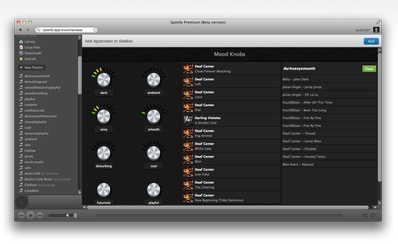
MoodKnobs

Mood Knobs was shown off at the London Music Hack Day 2011. Developed by Alex Michael, it is a Spotify hack that allows the user to navigate millions of tunes by precisely telling the app about various aspects of their current mood.

The selection and programming of music, goes the argument, is the most human element of what we do as traditional DJs, and as this skill could never be replaced by a computer, we’re all safe.

But is that really true? As computers “learn” about our musical tastes, could a computer program perform for a crowd just as well as a flesh-and-blood human DJ?

Consider this fact: Digital music platforms such as Rdio, Spotify, Soundcloud, iTunes Genius, or social music platforms like Turntable.fm are great evidence of the power data plays in the way we listen to music today.

These services collect data on what we listen to, and based on our input (“liking” or “disliking” a track) these platforms build stations based on tags such as genre, and build relationships to other similar artists. Some say we are essentially “teaching” the machine about what type of music we want to hear and how (or in what sequence) we want to listen to it in.


Computers can get better at DJing, just like humans

This process is being refined with every mouse / trackpad click. Pandora is an example of the powerful role sociability and personalisation can play in the way we listen, actively, to music.

I remember listening to Pandora around 2008, and it was not nearly as entertaining to listen to as it is today. This has to do with my input over time.

I do not see much difference between a novice DJ learning how to program for a crowd, and algorithm that chooses music based on previous choices…

If computers can “learn” to improve upon their already existing algorithms, then I do not see much difference between a novice DJ learning how to program for a crowd, and algorithm that chooses music based on previous choices.

Eventually the novice DJ, if playing for crowds, will most likely improve. On a computer, with every like and dislike that a user submits to a music platform, the music choice algorithm improves.

Now, you may be saying: “Well there is a difference between a computer selecting for an individual based on their own personal preferences and a DJ selecting based on how he or she is reading the mood of the crowd, right?”

Why DJing can be as much luck as judgement

Yes there is a difference, but the selection method when reading a crowd is entirely a gamble.
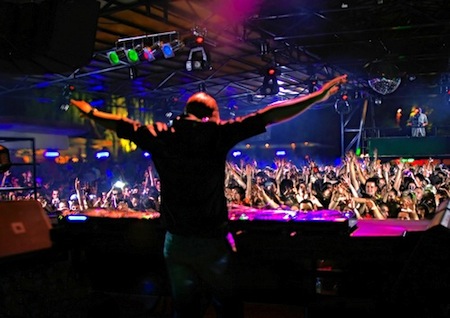
DJ crowd

Can he really claim to know what each and everyone of those people want to hear next?

You have to be able to make decisions based off subjective data: what the crowd danced to for instance, or remembering the tracks you played before, likewise remembering what the crowd enjoyed, as well as what they didn’t, and then being able to plan a musical journey from there, and so on.

This is unreliable because of the possibility of human error. You cannot truly know what the crowd wants to hear without asking them directly.

However, what would happen to a DJ’s set if he or she had real-time data from the audience, sent by club patrons in the same way we like or dislike tracks on our Pandora stations? This way we know what would entertain the crowd with some degree of accuracy.

I for one would trust this as an indicator about what my crowd would like to hear more than say, occasional requests by the drunk lads and ladies prying their way into the booth!


Is this the dancefloor of the future?

Imagine a crowd collectively providing data by liking or disliking a track the “DJ” is playing, making requests from kiosks in the club or from their mobile devices.

This would be too much data for a human DJ to handle (especially after a few drinks!). The clubbers are telling the DJ, in real-time, whether they approve or disapprove of the song selection and mix. The DJ uses this feedback and compares all other data points against the current track selection and adjusts its next track selection accordingly.

Phone clubber

Instant feedback to a computer DJ: Is this how it's going to be? Pic: Sephie Bergerson

Sounds like something a computer could do? Absolutely!

Theoretically, the computer DJ could simultaneously match genre, tempo, timbre, date of recording, and any number of data tags tied to the track that is currently playing, and then, comparing this data to other tracks in its catalogue, pick an ever-more “perfect” song to mix next.

On the human tip, this sort of involvement from attendees strikes at the essence of what some feel we do as DJs nowadays; being the central figure/concept in DJ culture.

Might this all take us back to the future?

But before the culture entered the superstar DJ era, we were just thought of as the leaders of a party. I remember hearing stories from my mentors about how they would love to, “give a party” to people.

A part of that “giving” aspect is performing for your crowd – knowing the state of music culture at a given time and creating a musical story or soundtrack, reflecting the time and space, for the people involved on the dancefloor. It seems to me that the people used to be a more active part in the process back then then superstar DJs often are now.

With newer technology allowing the crowd to democratically program, we might actually get back to the roots of DJ culture…

With newer technology allowing the crowd to democratically program, we might ironically end up getting back to the roots of DJ culture in which the community mattered as much as the DJ at an event. This would be a big cultural deal.

Ray Kurzweil, noted futurist and famed studio sampler engineer, predicted that man will merge with machine by the year 2045.

While how profoundly and how fast computers and people may merge is a bigger argument, it no longer seems such a massive leap to me that the last great bastion of our craft as DJs – music selection – could be automated. And pretty soon at that…

• Matthew Owen Reininger (DJ CNTRL) is an educational technologist and has been a DJ/turntablist for over ten years. He currently calls Circuitree Records home. Thanks to Rob Dyson, producer and engineer at Wizkid Sound in Atlanta, GA for contributing to this article.

What do you think? Is truly automated DJ software, with some kind of audience feedback, just around the corner? How well do your internet tastemaker streams, web radio channels and social streaming service predict your musical wants and needs? Or will there always be the need for a human to be creative in a way computers could never replicate? Over to you…

Now go to:
Are Robots Going To Replace Human DJs?
10 Types of People Who Make Requests (And How To Handle Them)
Is It OK To Beatmatch Using Phase Meters?

Want to escape the bedroom and play in public - fast?
Our 1000s-selling How To Digital DJ Fast video course shows you how.

Learn to DJ Free - email course plus bonus PDF book
Sign up for our weekly email course for beginners now...

Trouble choosing a controller? Visit the web's #1 guide!
DJ Controllers: The Ultimate Buyer’s Guide 2013.


Tags:


Creative Commons LicenseThis work is licensed under a Creative Commons Attribution-NonCommercial-NoDerivs 3.0 Unported License.

58 Responses to “Are Computers Going To Completely Replace DJs?”
  1. So when AI becomes self aware… the first thing on his mind will be playing some drum and bass? PHAT.

    [ link ]
  2. Volker says:

    I would rather ask:
    what is the creative part of a DJ set (there is no THE DJ, too many different jobs and roles out there). That’s what will keep DJ ing alive longer than expected. Just like vinyl because of the specific creativity it allows. CDJs and Digital allow other creativity.

    My guess is (e.g. see Girl Talk) that production, sound engineering and remixing will merge and will allow for new stage personas and scenes to emerge.

    Fundamentally, a computer can ONLY repeat stuff a human told it before. This means (currently): no creativity, no underground, no off-beats, no non-average, no new with computer-only in sight.

    About the “crowd sourced playlist”: that will only give you the average (top40, maybe down to genre), never anything unexpected. (try to find new bands you never heard of via genius, ping, last.fm or whoever)

    Look at software all over the place: it NEVER does anything new. It only repeats stuff (quite fast and quite reliably:).

    My summary:
    there will be lots of changes and many things we consider as creative (read: elite, subjectively) will suddenly been proven repeatable (read: done by everyone/a computer).

    Creativity will allways be the human playground and as long as we got young people brave enough to jump in, beautiful music will come out! (And I will be amazed and think: “why the h**l did I not have that idea!”)

    [ link ]
    • Eric says:

      lol yes!!! Exactly what I was thinking. Well said. Computers will never ever ever replace the actual dj. Top 40 can go suck a big one.

      [ link ]
  3. It’s theoretically possible, but the computer required to be able to read a crowd would take up half the building as there’s few things in the world as unpredictable as a crowd of humans. Just look at how much computer it took to beat a human at Jeopardy.

    Granted, as technology advances, the tech will get smaller and it’s not unreasonable to presume there’ll be guys who try and program something like it (my Dad’s convinced it’s possible), but for now, if you want a robot DJ, you’d be better off sticking with Daft Punk for now.

    [ link ]
    • You are right humans are unpredictable…but if they send information directly to the computer DJ, the data is direct and accurate on what the crowd likes and does not like. However, I think finding the right algorithm to process all this data may take some time to become accurate.

      [ link ]
      • MOB says:

        They can send all the information they want for all i care. I wouldn’t trust any of that unless it was a top 40 night. Or else you’ll get a thousand request for the latest shitty track that is going on and on everywhere in the middle of a techno set.

        Unless, we conceive a true a.i. , then i’d let it do “his” thing. Until then no amount of data mining can come up with an unknown gem that will make everyone crazy without even having it heard before.

        [ link ]
      • Matthew Owen Reininger says:

        The idea is not to “request” a track (maybe that could be an option). The idea is that a track would be played and it could be “liked” or “disliked” and then the robot DJ could compute that information and select the next rack (not requested specifically) and mix it in….

        [ link ]
  4. LewisLace says:

    this is scary

    [ link ]
  5. flyer says:

    Shitty dj´s beware! ;-) I know some dj’s I gladly see replaced by a computer. A good playlist in Itunes can alreaddy replace a rookie dj who just want to play he´s stuff no matter what.

    But, there will always be a need for real dj´s who passed the point of trying to follow the crowd and moved up to leading it instead.
    If we can´t entertain the crowd better than a pc or mac can do by themself, we just have to get the f**k out of it’s way……….

    [ link ]
  6. totally are with flyer.
    I can see small clubs/bars with computer DJ’s like this but I do not really thing all DJ that play larger places will be replaced anytime soon.

    [ link ]
  7. Stazbumpa says:

    We already have dance floor democracy that programmes DJ sets; it’s called “requests”. What we lack are DJ’s humble enough to play requests. I can’t see it happening anytime soon, you cannot programme a computer to feel the vibe of a dance floor and you certainly cannot programme a computer to stick its neck out at the crucial moment and throw a track in from left field, that nobody was expecting, that can potentially take the roof off the place. Only us mere humans can do that.

    [ link ]
  8. Great post. Very interesting point relating what computers could do with how the whole profession of DJing started out, “giving people a party”.

    I think there’s definitely a place for the kind of computer DJ you describe – responding to requests in bars or clubs, or creating a set based on crowd responses. That could be a new genre of club night of the future. It would have its fans for sure.

    On the other hand, the idea of a DJ just playing what people want sounds awful. I want DJs to play what they want, and do it well, and be interesting! That’s what people pay to hear isn’t it? Why would I take the time and effort to go and hear Andrew Weatherall or Surgeon play, if all they were doing was playing what everyone wanted?

    “Another way I manipulate the symbols of music is by not giving people what they want all the time. I use frustration as a tool, and work with a model of tension and release. For instance, I play something that’s deliberately difficult and unfamiliar – so people won’t like it. And then I give them a reward or resolution, moving on to something they’ll like. It’s not sadism – it’s a balance of pleasure and pain that makes the whole thing work.

    I also feel it’s important to love and respect the people I’m communicating with. If I don’t, it becomes sadism, which is not fun for me personally. Even if there are parts of my set which are harsh or difficult, I always provide some resolution.”

    (Surgeon interview, 2011.
    http://www.semionaut.net/habitual-symbol-manipulator/)

    [ link ]
    • Phil Morse says:

      Hi, Olaf. That’s a great Surgeon quote, thanks for sharing it.

      [ link ]
    • Matthew Owen Reininger says:

      Thanks for this perspective, Olaf.

      The tension and resolution is so important for an interesting DJ set, I completely agree.

      But continuing with my devil’s advocate argument- is that not something that could be programmable as well? We, as DJs perform an equation with variables every night…if/thens, so to speak. It seems that this sort of action could be another type of algorithm a program could be taught-especially if it was programmed by DJs too. Any thoughts?

      [ link ]
      • Scott M2 says:

        If a DJ can clearly state a strategy then an algorythm can be built. ie the tension and release.

        [ link ]
  9. Derek Turner says:

    Great article – really gets the imagination firing. I have no doubt this is possible. The ‘AI DJ’ could makes selections based on local iTunes charts, live sms responses from the punters in the venue, & perhaps even monitoring the the noise levels of the punters. I can see a ‘rating’ for each song in regards to intensity or mood being introduced. & Also different ‘programs’ so the club owners can periodically clear the dancefloor & drive the patrons to the bar (You know they will !)

    The flip side of this is that seeing a superstar DJ is a shared live experience – youre actually in the company of one of your favorite artists – which you wont get with a machine – even if it executes a perfect sequence of music.

    [ link ]
    • Matthew Owen Reininger says:

      Hi Derek,

      One point I should have mad clear in my article was that this concept was really realized thinking about the DJ who does not produce. Most of the superstar DJs are superstar producers, so seeing them live is still relevant and worth the shared experience as the music they produce is uniquely a product of theirs. I do not think seeing Amon Tobin in his cube or Daft Punk in their multimedia pyramid will ever go away. It’s more of a concert than a DJ set-imo.

      This argument was made with all of us in mind. The DJs who perform (primarily) other people’s music in a unique way…

      [ link ]
  10. Steven Jacobs says:

    There is very much different type of DJs.

    I think for the typical Top 40 DJ or like a Wedding DJ this would actually work. Where there isn’t any real blending of tracks. All it is is going from one song to the next song. I can totally see this taking over.

    But if you look at it from the Underground DJing perspective…stuff like this will never take over. why? Because the people who goto these underground music clubs and underground DJs often have a very strong connection to the DJ and with the music they are spinning.

    Prime Example:

    DJ A has 3 decks going and is mixing House, he is completely blending 3 tracks togeather with proper eqing, swapping basslines, mids and highs on time and creating a whole new song out of it.

    A Computer program doesnt have the “creative” side that is able to do this. a Computer does what it tells you…it doesnt have an actual “personality” so to speak.

    Honestly I welcome the days when the Computer takes over the Top40 and mainstream clubs…its not like they are actually Mixing in the first place

    [ link ]
    • Matthew Owen Reininger says:

      Hi Steven,

      I respectfully disagree.

      “DJ A has 3 decks going and is mixing House, he is completely blending 3 tracks togeather with proper eqing, swapping basslines, mids and highs on time and creating a whole new song out of it.:

      All of these function are variable that can be possibilities which a computer program can calculate and perform. Now, you might think that the computer could not do it well, even though it is possible that it might be done. This is true. However, I have seen so many DJs in the past do exactly what you described and these human DJs did a pretty poor job of all those functioned you described. It works both ways.

      I’m not sure if you saw any of the most current Ultr aMusic Festival streamed, but I saw so much of what we expect a DJ to do, basically automated. If I had gone to to festival and had the birds-eye view the cameras gave us on the Internet, I would be really upset I paid to see these DJs “perform”.

      [ link ]
  11. Bart says:

    The playlist thing in bars & small clubs some people are talking about is allready done ages ago … it’s called a jukebox. A jukebox had it’s place in many bars but on saturday nights when the place is packed and more “partystuff” is needed it was bypassed and a dj did his job.

    So making the crowd create the playlists by sms or something will just equalize all bars & clubs since they will all spin the same rihanna & guetta tunes.
    And the few actually knowing band-names and songs will program the music, especially in venues where a more underground music choice is at hand. On your regular techno party 90% of the songs are unknown to the masses only the biggest classix and club bangers are known.

    @Steven … it is just depending on the allgorythms you are creating. You can make perfect blends just by programming them. The non vocal music genres arefairly easy.
    In traktor for example you can midi program a complete blend A-B under 1 button or knob. Moving the channel sliders, taking out the bass, mids, highs … but you have to create several allgorythms to get some variation.

    But the discussion is pretty pointless … a dj is considered an artist (some have at least the status). A painting machine didn’t stop painters to create art, but it gave some of them the ability to do graffity and other to becoma airbrush artists. Automatisation doesn’t stop creativity, it delivers opportunities …

    [ link ]
    • Matthew Owen Reininger says:

      Bart,

      I like what you said here: “Automatisation doesn’t stop creativity, it delivers opportunities …”

      I totally agree. I wrote this piece thinking in the back of my mind, I hope it inspires us as DJs to really push what we do forward.

      There is not a doubt in my mind if someone creates and licenses a “mechanized DJing service” of sort, that more than half of the venues we all like to play in will use it, as it would be cheaper in the long-run, and as we know from the Internet, a social experience together, with our technology sells (think karaoke).

      We need to REALLY IMPRESS our audience nowadays. Remixing is the name of the game it seems.

      Hopefully few songs we play will ever by the sam if we hope to not be replaced by machines!

      [ link ]
  12. Caspar says:

    *sigh* – that surgeon quote nailed it. You don’t go to a club and see a DJ to hear the music you know you want to hear. The best gigs suprise you, keep you wondering what’s going to happen next. Seeing the connections DJ’s draw between different artists and genres is one of the reasons I (at least) go out. A computer might be able to select another song similar to the one being played, or put on the most requested one by the crowd, but it won’t draw a connection between a new tune and say, a Stevie Wonder break from 30 years ago. Sure, that system described might be put into place at a standard bar with no real music policy, but I really think this article misses what DJing is about.

    [ link ]
    • Matthew Owen Reininger says:

      Caspar,

      I don’t see how hard it would be for a computer to figure out that Nicki Minaj’s “Lil Freak” has a sample from “Steve Wonder’s “Living For The City” from his 1973 album “Innervisions”, and then throw everyone for a loop bridging the hip-hop/r&b/rock gap by playing Stevie’s Higher Ground” off that same album and mixing it with the Red Hot Chili Pepper’s version of “Higher Ground”. All of this information is available and could be programmed…That is exactly what on part of DJing is about…making connections between what the crowd is listening to and educating them about relationship of songs!

      [ link ]
  13. ellgieff says:

    Jukeboxes already exist. They haven’t replaced DJs yet.

    [ link ]
  14. DJ Forced Hand says:

    There’s already a meme out there” If you’re not better than an iPod on shuffle, then you’re not trying hard enough.” Now I’m sure there’s only a limited amount of stimulus and response that correlates “optimally” to a popular club night… but that’s not expressing emotion and I think that humans want to experience a fully emotional set. How do you define an emotion in computer code? How do you express looking into the crowd, seeing something and linking that with a memory that is associated with a previous personal experience?

    Maybe one day a computer will scratch and maybe someday a computer will drop the glitch, whatever will replace dubstep or overdub sample moments but it’s going to be so hard to get a computer to… make a value judgement and then make an emotional decision and then decide “I think I like this but I like this better and even though those people like this direction, I’m going that way instead, but no I’m not… just kidding here’s what you want… kinda’.”

    Computers can do a lot of things, but making rational, irrational decisions and playing songs on a whim which fits, but it’s not even remotely related to what’s been playing are not it’s strengths. When a computer can can be more creative than the best humans, we’ll have no need to do this work anymore, but I don’t think programmers are approaching the correct things to obsolete us… at least right now.

    [ link ]
    • Matthew Owen Reininger says:

      Hey DJ Forced,

      My thoughts on what you wrote: ” make a value judgement and then make an emotional decision and then decide “I think I like this but I like this better and even though those people like this direction, I’m going that way instead, but no I’m not… just kidding here’s what you want… kinda’.”

      This is an if/then statement. The program could do exactly this. It could execute any of these possible moves, but it has input from the crowd to know how far left field it might go to throw the crowd for a loop, without completely losing them. This may take awhile for the program to get right, but since it is capable of learning from feedback it would eventually improve, theoretically.

      “When a computer can can be more creative than the best humans, we’ll have no need to do this work anymore, but I don’t think programmers are approaching the correct things to obsolete us… at least right now.”

      Amen to this….Let’s get more creative as DJs than we already are!

      Companies replace worker for machines when they can get the same end result at cheaper costs. Unless we assume our audiences stupid, and as kids grow up expecting something more form what DJs do with their technologies, we need to out-smart the machine which may come along and outbid us for our jobs.

      Creativity…Creativity…Creativity. It’s what we need to push forward, as human DJs-constantly.

      [ link ]
      • DJ Forced Hand says:

        Hi Matthew,

        I know you can program something based on known mathematics and equations, that’s why I was showing the parts that don’t link-up… square pegs don’t fit into round holes (unless they’re smaller than the hole, but that’s off topic). At first blush, my comment looks like all you need to do is apply simple operators (if, then, or and etc.), but it’s really hard to define “value judgements” and “emotional decisions” so it’s really not a simple process. Basing a decision partially off an emotional response isn’t really linear either. Decisions made like this revisit data for different aspects and humans make decisions based on (among other things) their current take on morality, personal mood and motivations which are all likely change somewhat quickly and… be influenced by the music.

        I know companies could crowd-source or out-source, for creative teams but they won’t computer-source at least until computers can make compelling arguments to consume things based on something that evokes a positive emotional response.

        The sign of a true master is making something which is difficult seem easy. I believe what we’re seeing now is a lot of companies trying to emulate the human through software and they’re realizing it’s not so easy to be “the DJ.”

        BTW, When we get a computer that good, we will have finally figured out women, so… win-win!

        [ link ]
      • Phil Morse says:

        So that begs the obvious next question… Will robots replace women? ;)

        [ link ]
  15. DJ Forced Hand says:

    …and I didn’t even touch on the whole DJ as a performer side of things… getting out into the crowd, bringing a fan on stage, interacting with the fan and then doing something colloquial, yet recognizable by the community. How do bottle Mojo?

    [ link ]
  16. dougtek says:

    Has anyone remembered the value of a quality dj SHOWING you what good music was? When you bought a cd (years ago im sure) and listened to it twice before you got it? Stood in line to get into a fat venue to hear a headliner drop tracks never heard before? No code or program will ever be able to do that. AI be dammned!

    [ link ]
    • Phil Morse says:

      Thats the big argument, of course – computers cannot innovate.

      [ link ]
      • Matthew Owen Reininger says:

        Would it not be possible to have producers feed new and/or exclusive tracks to a networked of connected “robot DJs”, and drop those tracks in the same way we do as innovators?

        [ link ]
  17. Howitzer says:

    I agree with the article, its a natural evolution of our species to replace menial jobs with computers & robots.

    I dont see DJing as menial though.

    My biggest concern with something like this is a dancefloor by democracy. For instance and sms/twitter feed that reads requests and plays them.
    If youre enjoying the music why would you text a request in?
    The people not enjoying the music will be probably be requesting a different genre.
    If the computer was to pander to this request you split the dancefloor, kill the vibe, etc. Spam that a human DJ can filter and control but a computer wouldnt know.

    Whilst this could be learnt by a computer over time, it’d take lots of broken dancefloors before you’d acheive a credible set.
    By which point I think the club would have lost its patronage.

    [ link ]
    • Matthew Owen Reininger says:

      Howitzer,

      That’s a great point. There would have to be more direct, and passive way for the “robot DJ” to know if the crowd was enjoying what was going on. I gre with you , I t might be the dissatisfied patrons who would be interacting with the robot DJ the most. Other cues would have to be considered.

      Maybe scanning the crowd noise level (Thanks Derek) and sensors in the floor for how much dancing was going on, etc.

      [ link ]
  18. Pete Simpson says:

    I’ve spent the last month or two reading a lot of papers, both theoretical and applied, that investigate the ability for computers to “recognise” music, and determine qualities that can be used to automate the DJ process. After a while, any attempt at navigating through this with pure mathematics and logic will see you grounded on ontological rocks. The more accurate methods currently employ learning algorithms. I’ve seen some crazy things done by applying such methods, in many fields of study.

    I recall a video where some university had created a virtual surface, created virtual human bodies, and gave them primary movement skills and senses to avoid virtual harassment from the operators, then started harassing them. Each iteration of these “humans” would die out from not avoiding the harassment of the operators, then they would take the imprints from the learning experience of the survivors and “mate” them, for want of a better word. The results were spooky, these little rag dolls flinching as virtual implements were thrust towards them, tripping over, scrambling to get up and run away. The behaviours they learned looked real.

    So a machine, scanning hundreds of music feeds from popular DJs, looking at what’s popular, qualifying tunes for sets from thousands of different perspectives and with the knowledge of all that it and it’s crowd source of computer buddies has tried before, it could fire out some brilliant sets. But so could you, and you can self-program, you don’t need a corporate sponsored team of computer scientists to make you do it.

    As always, any argument that such intelligent machines can replace human endeavours in that field can be easily countered with retorts that have no basis in provable facts. Rightly so! Plato attributed Socrates with a quote “The only thing that I know, is that I know nothing” or something to that effect. Man does not understand himself, so can not make a distinction based on facts when relating human to anything.

    That said, I’ve heard automated playlists that were better than some DJs I’ve seen playing at clubs. A time will come when automated playlists will out-perform all but a few. Make sure you’re one of those few :D

    [ link ]
    • Phil Morse says:

      It brings to mind chess computers, which again can beat all but the very best.

      [ link ]
    • Matthew Owen Reininger says:

      Pete,

      Well put: A time will come when automated playlists will out-perform all but a few. Make sure you’re one of those few.”

      That is exactly what I see as a possibility. The human element is crucial in what we do. I remember being so inspired by one person I saw DJing (at an early age). It was not so much what he was playing-but how he played it. It was the connection between his creative vision, the technology (mixer, turntables, and vinyl), and the crowd. This DJ also was a musician. He produced tunes and mixed those in with the records of others to tell a larger story that night.

      These types of DJs, I believe, will never go away.

      This article was written as a challenge to all of us. I think the art of DJing is serious. We CAN be musicians. We CAN be artists,but we have to be Jedi masters about what we do and, think 2 steps ahead of everyone else in the game.

      Maybe Socrates was right…Man does not know himself. His rationality is limited to basic understanding of the physical word. Can artists transcend to a heightened emotional state-”the zone” as some people call it when they are in what Mihály Csíkszentmihályi called “Flow”? I think so, but it is rare if we do not challenge ourselves to be better than other in what we do. Machines can be just as good as one another and not necessarily have the benefit of “ego” to push their creativity forward in the ways that we can as humans.

      Maybe I am going to far with this but I feel that while the much of DJ culture is becoming more and more mainstream, the quality and creativity in what we do can be compromised by the marketing and fashioning by outside forces deciding what a DJ should be. Think about the trajectory Rock n’ Roll went through…and Hip-Hop.

      We need to step up our creativity. I am glad to see so much encouragement of that on this site with promotion of mash-ups, remixing, and production over just playing tunes in a certain order.

      Long live the (human) DJ!

      [ link ]
  19. spektakx says:

    yes, absolutely. beat me to it with the chess computers comment.
    there is some very interesting work going on with monitoring the sound, harmonics, resonance of the heart as it relates to happiness, health, and most importantly “bliss” search for dan winter on youtube..and prepre to have your wig blown completely off. try this one first, and just imagine a party where, as you come through the door, you are given a wrist-band heart harmonics monitor which sends bio-feedback to a computer that monitors in real-time how much bliss is being produced in the crowd. After a few parties, the computer would have a frequency/key/bpm baseline against which to program a set. Check this video for a demo of the product which Dan say cost about $1000 US http://bit.ly/Kownye

    [ link ]
  20. Dan says:

    GOGO garbage in-garbage out.

    [ link ]
  21. Halvparten says:

    It will survive in the same way vinyl, cassetes and leather jackets do; because it looks cool.

    [ link ]
  22. D-Jam says:

    I’ve read about the means to make this happen.

    Unfortunately for the computer, I still think that a human mind is necessary to really explore music. All these programs and such that are built to simply read on inputted data. Even the Mood Knobs program mainly works on how the programmers/admins input keywords and ideas into the tunes that sits in the database.

    So you put in “energy”, “funky”, and “sexy” as your moods or desires for music. What happens if everyone suddenly makes sure those keywords are in their music? What if you suddenly are handed dark minimal, dubstep, and tunes that are anything but “energy”, “funky”, and “sexy”? This is what many do in SEO when it comes to websites. They simply try to lock on to popular terms…even if their site has nothing to do with it. Thankfully, the search engines are smarter.

    On top of that, what happens when these systems become “pay to play”? What if big corporate music labels now pay money to get played in the clubs that use these systems? What if a big label pays or pushes to get played every hour or in the prime time of the night? You pretty much then put a radio in the DJ booth.

    If you’re a mainstream DJ who plays in tourist traps…then you might want to worry. I can see even mobile DJs worrying if halls and venues stock this and offer it as a lower-price solution for a DJ. However, the underground won’t change. They’ll want a human being in the booth, and someone offering HIS OR HER TASTE to the mix…not popular opinion. That’s what the underground and even global thing has been about…the DJ as a tastemaker. No computer will ever replace that because you would then need similar minded people seeking out and adding the music to the databases.

    Computers do not know or understand “taste”. That’s the element a human DJ has over a computer.

    [ link ]
    • Matthew Owen Reininger says:

      Hi D-Jam,

      I hope you are right-”Computers do not know or understand “taste”. That’s the element a human DJ has over a computer.”

      How do you account for the constant improvement of social music station like Pandora becoming more refined in selecting the music for users’ custom stations over the years?

      Can “taste” be taught to a computer by users who are DJs, hired to help program machines?

      Curious about your thoughts on this.

      [ link ]
      • I agree with D-Jam. However, I believe anything programmed or automated CAN work within context:

        Clubs
        DJs are emotional and versatile. They are continuously assessing the dance floor and making small adjustments with every track to take the night to a climax. Plus us DJs perform a lot of call-and-response techniques like: playing uplifting gospel vocals when the big girls show up or go to a 10 minute percussive track to make b-boys dance. All of these decision are emotionally and psychologically based on millions of variables (good luck building an algorithm for that). Like D-Jam mentioned above the energy has to be 100% organic.

        Radio
        I come from a satellite radio background and music programming is a lot of work. It’s not realtime as DJ’ing though and replacing the human aspect of programming with an algorithm (like Pandora) is absolutely possible. A lot of radio jocks will disagree, but Pandora has successfully created the music gnome which carefully adapts to the listener’s tastes. Any algorithm will evolve to achieve a certain purpose and however AI’s are different ballgame.

        Asking if taste can be taught to computers who are DJs is like asking to have a computer based F1 Formula cars compete in race or R2-D2 babysitting your 1 yr old infant.

        Thought provoking post Matthew, thanks for posting!

        [ link ]
      • D-Jam says:

        It’s easy to figure out the taste of ONE person. All those programs do is take your preferred tunes and guess others based on what others like. So if you and 1000 people like Deadmau5, but also like Skrillex, then the computer will suggest Skrillex tunes to you when you’re listening to Deadmau5 because of how many people like both.

        It’s the same as when Netflix or Amazon recommends things…or when you see “Users who bought this also bought…” on music sites.

        The problem though is this is still mathematically taking USER INPUT. Taste is when you’re the one picking and choosing based on only your personal likes/dislikes with no other outside input on what to pick or what people are into. If you took away the voting and user inputs from listeners and told the computer to “pick music you like and/or believe in”…the computer can’t do it. Not until we really build sentient artificial intelligence that can think without a human giving commands.

        One’s taste can be learned…but it doesn’t mean the computer has developed its own taste. I know when I tune into a DJ set of a DJ I like, it’s because I want to hear his/her taste in music.

        [ link ]
  23. DJ Forced Hand says:

    OK, why then don’t we consider these computer DJ programs as Advisers rather than Adversaries? We already use our laptops and controllers as tools that help us out, why not consider a little help on the advice-side of DJing. I can tell you there were times I DJed myself into a corner and wish I had more than luck to guide me out.

    [ link ]
    • Matthew Owen Reininger says:

      That’s such a great idea. Man that’s a really good idea, DJ Forced.

      I wonder if our egos as DJs get in the way…will be trust the computer to partner with us in selection? I guess that’s a personality-related question.

      [ link ]
  24. I’ve already witnessed bars using a fixed playlist. Yet, I can’t see a computer taking over the human DJ. Trust me, you do not want some people picking music. I keep thinking about that online Jukebox. I love it and I hate it. As bar patrons enjoy another person’s pick, here comes someone picking music folks really hate. Then you have those types who sit back and let control freaks takeover. I would just love seeing a bar or club attempt using a computer. Because they would be using a computer as means to being cheap. Then, I would enjoy seeing it backfire.

    [ link ]
  25. Attila says:

    It’ll happen, but it won’t make a difference within the next couple years. I think Traditional dj’s that are just playing music are going to die out soon, instead leaving producers that people want to see live, especially with how quickly electronic music is becoming accepted in the mainstream. I think it’s obvious that clubs are the new concert hall of the 21st century.

    I can definitely see computers taking over regular nights when there aren’t any shows being played. It’s just the consolidation of tasks, like how most every other industry is evolving. Just playing music isn’t going to cut it anymore. If you can’t draw a crowd that are there to see you, then you’re going to be SOL.

    [ link ]
  26. Sivaraman says:

    AI is good. i had worked with that technology for a while its like a baby when you implement within few years it will be a fully grown adult only thing important is what you feed in to it. if your data is good results are amazing if data is bad a big failure.Absolute truth is computers will be a part of human life in few decades from now let it be a DJ or women or national security or president bla….bla… until unless if humans realize the consequences. The true Nativity of humans so called love – hate – belief – trust etc will be perished

    [ link ]
  27. djcl.ear says:

    Uhmm.
    hahaa I read my post and cannot believe this thread has brought out this acidity. Nothing personal, just saying.

    @ Matthew Owen. The fact that you start proposing the DJ-machine argument and half way thru this thread you repeatedly state; “long live Human DJ”, “Creativity is king” etc, together with your (displayed) knowledge about automated processes in music and summed with your close following and answer of (interestingly angled) responses… gives me cue to several hypothesis including that you are interested in developing or commercializing this field.

    Whatever it is, there is a said trail to this old story as WO well stated; “The Gold keeps glittering just enough to keep you hypnotized” And so the automated-DJ had been created time ago(jukebox) and will continue to develop as long as the coming machines find a market to sell.
    Which is not bad in itself, except about the “hypnotizing” part of equation, the same way an untalented new DJ might please a crowd (and the place owner with his low cost) for a short while and soon project out his shortcomings.

    @DigitalDjTips Community:
    ///Being a Dj means, -as being a human or more so, being an artist- means always evolving and traveling to the unknown.
    Sometimes this journey means discovering great news that the explorer can bring to the community and both the receivers and the bringer benefit.
    ///Being a machine, instead, is following a code, many times under the power of other humans who instead of traveling to the unknown, choose to profit from other human explorations and fastly copycat them… and hence many of these created devices do follow schemes and business strategies.

    I am not saying machines are evil, as said up there, they are tools, great ships indeed, however if we are talking about creativity v/s replication, the fairness angle must be brought out.
    Because, it is close to the creative people where you find the ones who are more interested in the replication side of things rather than the exploration of new.
    I’ve seen to many examples where great ideas and talent is so fastly replicated by a glittering (someone, something) that the original explorer and creator has not even given the chance to recover the energy he invested in the journey.

    Hence, as well as a DJ should focus on creativity and advancing, should also be aware that instant careless disclosure is not so conducive in a world where replicators and copycats take rapid advantage without a second sight or respect to where it came from.
    Traveling to the horizon takes energy as any seasoned Dj knows.

    [ link ]
  28. Chris Argueta says:

    A computer could NEVER do what I do. Every time I spin, I do something different. Even if the competing computer/robot DJ had every track I have and bought the same music I buy, it still could not do what I do.

    Algorithms don’t equal soul.

    It might someday sound kinda like me, but it will never be me.

    If you think that as a DJ you may soon be replaced by a machine then you should find something else to spend your money and time on.

    DJ’ing is not for you.

    [ link ]
  29. Chrisneil says:

    The whole point about the music especially house music and its variants was the fact it was tied in with a cultural movement,political,social,the dj’s at the time brought about a vast change in the music we listen to and how it was presented,this human side can never be replaced by machines,they just dont have the random intuition or emotional connection to ever begin to be on a par with the best dj’s,wether a future generation will actually bothered by this human connection remains to be seen…

    [ link ]
  30. spektakx says:

    I,too, have some thoughts on this subject
    http://spektakx.com/2012/05/23/will-computers-learn-to-mix/

    [ link ]
  31. Gary says:

    You’re taking the piss right? comments like “if technology can now perform these actions for us, how much of a skill was it really in the first place?” make me think so..
    Basically that’s like saying being able to perform advanced mathematics is not really a skill because a computer or even calculator can do it in an instant.

    Using computers to replace people especially where creativity is involved completely removes any soul and warmth associated with the task. Are you impressed when your calculator works out the square root of 741? or would you be impressed if a person could do it?

    Another point i’d like to make concerns not only this article but most that relate to this topic or similar. I’m sick of people saying “It doesn’t matter what you use, as long as the crowd is dancing” or “Any DJ who doesn’t use digital is going to be left behind”
    Whatever happened to playing for yourself? So what if I prefer to use vinyl, it’s because I LIKE IT! not because I think it’s superior to digital. And i’m certainly not going to be “left behind” because there’s nothing to keep up with!

    DJing is an art, not a competition.

    [ link ]
  32. Steve says:

    Computers cannot feel the energy of the mix and “when” to mix..we’re cool..no club crowd as a group knows “when” to mix..again we’re cool..replacing phony-push play DJ’s or Mock Jocks by computers..that’s cool

    [ link ]
  33. luke james taylor says:

    It’s true computers could do this; Especially in a commercial club where music is all about popularity. If the crowd want to hear the top 40 then the computer will quite quickly zoom in on those few tracks and work from there.

    But when it comes to educating the crowd this theoretical computer is a slave to the whims of popularity.

    The best DJs make the crowd enjoy what they least expected and to do this you must push against popularity.

    If it was all about popularity we would never have had the musical innovations we have had.

    Good music bucks the trend, a popularity contest is the tyranny of low expectations.

    But even in a commercial setting you need know how. A computer might receive a large amount of “likes” for an old Madonna track then logically move on to Aqua – Barbie Doll or Whigfield – Saturday Night both of which are far to cheesy even for todays commercial crowd.

    The fact is commercial or underground the DJ is not a jukebox

    [ link ]
  34. James Argyle says:

    Very interesting topic! :)

    I don’t see any technical limitations to the concept of computers becoming very good dj’s. We can already program computers to discern patterns using AI techniques (Neural Networks, Fuzzy Logic, Probabilistic Modelling and Classification). To some extent, this is likely how last.fm etc work; comparing your expressed tastes with others and extrapolating this to make suggestions for other tracks. Currently, the only problem is that these services are heavily biased towards chart and mainstream music.

    That said, it wouldn’t take much to create an intelligent agent which shunned the mainstream and used our preferences to dig for alternative music. Indeed, at the simplest level, this would only require the addition of a weighting AGAINST popularity. For example, from a purely social perspective, I would teach my algorithm to prefer music that was liked by a smaller number of “astute” listeners rather than “the masses”.

    Additionally, we can go beyond the social networking metaphor and program an agent based on metadata (artist,label, etc) and waveform analysis (tempo, pitch, timbre or comparison with other preferred tracks). Crucially, we are also not limited to concepts that we can understand/articulate as humans either. This is highly relevant when we think of an individuals taste – e.g. I could play you a bunch of songs that I like but could I explain what it is that I like about them? In theory, by presenting a computer with a user ranked library of music, it could actually do this quite well. The quality of the results would be very dependent on creating a meaningful representation of the data, but I believe this could be overcome with enough research.

    The reality is, much of the this future technology is already here and demonstrated by features like beatbot – I find this already works quite well for my tastes.

    Where I disagree with the above article is that technology will lead us towards the ultimate conclusion that the dj becomes redundant. Just because we “could” fully replace the dj with a computer, doesn’t mean that we either want to or should. Dj’ing should be fun for both the individual and the crowd. Indeed, I’m not sure where the benefit is to either – cheaper nights and dj’s looking for alternative sources of income? Outside of chart, I believe that the crowd want to experience/see performances by quality dj’s and are willing to pay for that. Currently, I would anticipate a fair bit of resistance on both sides to this change?

    Where I see that this technology could be interesting would be for decision support of a human dj. As noted, this is already happening on websites like beatport where preferences are being modelled and fed back to the user. However, the next logical step would be to aggregate this knowledge into the crowd. If people were signing into an event for voting (e.g. via Facebook) there would also be the possibility to aggregate their musical tastes using statistics (if this information was available). Instead of presenting this information to a computer DJ, this might be available to the human as a summary of tastes?

    Clearly there are quite large information barriers to be overcome for this to work and there isn’t currently the infrastructure to provide/share this information. And even greater questions about whether we want to share this personal info with a third party anyway!

    J

    [ link ]
  35. Nick says:

    Responding to this a little late here. I’ve been thinking about the role of the computer in regards to DJ-ing a lot lately and, for better or for worse, I honestly think computers WILL have the ability to replace the DJ within the next five years.
    Think of all the software that already exists which can analyze tracks inside and out, catalogue them with extensive amounts of metadata, and determine what key they are in.

    The only factor that is missing, which I see unfolding during the next few years, is some sort of iPhone/Android app that functions in a similar fashion to Foursquare. How it could work is you walk into a bar/club, check-in through the app, and a list of songs pop up that are based loosely around what style of music is currently playing on the laptop. You can punch in a request, which is tabulated against the other requests people are sending it. The laptop then determines which song to play next, not just by request count, but also by figuring if it matches in key and bpm. Then the person who sent the computer the most requests is crowned the “mayor” or “champion DJ” or whatever for that venue for the night, giving incentive to engage with it just like on Foursquare.

    An app like that could be revolutionary, and I can see it having an impact especially on many of the top 40 venues. For EDM, who knows…maybe there will still be niche nights where “real live DJ’s” will still perform. At the end of the day, the only people who will be secure are the producers, who have unreleased content to play that nobody besides them or their close affiliates will have access to. They’ll still be able to play live, just like they always have. For everyone else, things will be uncertain at best.

    Of course it wouldn’t be just the DJ’s who would shudder at some sort of system like this coming out…the hardware manufacturers would be weary of such a thing as well. If bedroom DJ’s didn’t have any sort of incentive to play out knowing their job would be automated, most would probably not see the reason to justify the cost of buying that extra MIDI controller or CDJ.

    The next few years are going to be interesting in the world of DJ’ing for sure.

    [ link ]

Leave a Reply

Enter your details:

Or connect with:


Be constructive, be polite. Full guidelines here. Asking a question? Use the forum instead. Comment that don't meet our posting standards won't be published.


New to Digital DJ Tips? | What DJ controller? | Learn to DJ | Testimonials and Feedback | Privacy Policy