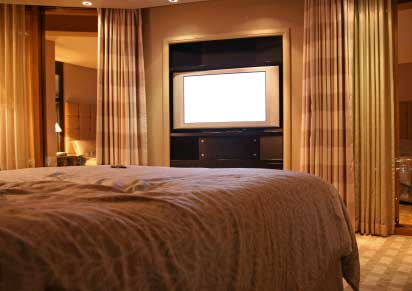
Curtains, rugs, carpets, beds... the more muffled your room, the better as far as great sound for DJing is concerned.
Last time in A Beginner DJ’s Guide To Monitors, Part 2: Positioning Your Speakers, we covered the basics to make sure that having got yourself some decent speakers to use in your DJ practice room, you know how to set them up properly.
This time, in the last of three parts, we’re going to look at how your room acoustics affect what you hear from your speakers, and some things you could consider doing to improve the overall “sound” of your room, in order to minimise any annoying issues.
Three tricks to making your room sound great
All of these three tricks are aimed at achieving the same thing as last week: Reducing the annoying effects of bounced or reflected audio, which can remove power and clarity from what you hear, and colour the sound in your listener position in other ways too.
- Move closer to your speakers – Before rearranging your room, adding any kind of acoustic deadening materials, hanging velvet curtains from your door, or anything else we’re about to suggest, try simply moving closer to your speakers (ensuring you preserve the triangle shape we spoke of last week between the speakers and your head, of course). This will have the effect of reducing the reflected audio you hear and increasing the direct audio, giving you a truer, clearer sound
- Use anything at hand to deaden obvious reflective surfaces – we’re not talking mirror-type reflection here, rather anything that will reflect sound back at you! So back walls and side walls are clearly bad, as are hard floors and ceilings. Breaking their big flat surfaces will help a lot. Ceiling-to-floor curtains, bedding, big plants, bookshelves (full), carpet, rugs and so on will all massively improve your room acoustics
- Kill corners – If your bass is boomy and indistinct, chances are you have a corner issue in your practice room. Bass in particular tends to skulk around in corners, and the best way to deal with it is to kill the corner. Corner furniture units are a good option, but anything that can break the 90 degree angle will help
No need to go crazy…
There are two plus points here for DJs. Firstly, many of us practise in our (often small) bedrooms. That’s great, because much of the above (if not all three, at least to an extent) happens naturally!
While it’s important to get ‘true sound’ for DJing, it’s not as important as for serious music producers
Secondly, while it’s important to get “true sound” for DJing, it’s not as important as for serious music producers, who often go to great lengths fitting acoustic diffusers, bass traps, and specialised absorptive materials to deaden reflections. For decent beatmixing and making reasonable sounding mixtapes? Thankfully you don’t need to be quite so careful.
By the way, I’m a little embarrassed to say that currently Digital DJ Tips has the worst room acoustics we’ve ever had to endure. We’ve added two rugs, a big sofa and blinds, but we need much more to deaden this office, which currently echoes like a library!
Finally…
This has been a necessarily short introduction to how to monitor your music in a DJ practice studio, but if you’ve taken anything away from it, I hope it’s that it is definitely worth considering carefully everything to do with your speakers.
Do so, and it will be to the direct benefit of your DJing, and without doubt will make your practise sessions much more fun – whatever speakers you can afford, and whatever type of room you have to practise in.
Have you tried weird and wonderful tricks to deaden and improve the sound where you practice? Are you a producer who’s gone to greater lengths than spoken of here? Or do you have a bedroom that’s so cluttered it’s just about perfect for DJing in anyway? Let us know in the comments!
Now go to:
A Beginner DJ’s Guide To Monitors, Part 1: Choosing Your Speakers
A Beginner DJ’s Guide To Monitors, Part 2: Positioning Your Speakers
Review & Video: KRK Rokit 6 Powered Monitor Speakers
Want to escape the bedroom and play in public - fast?
Our 1000s-selling How To Digital DJ Fast video course shows you how.
Learn to DJ Free - email course plus bonus PDF book
Sign up for our weekly email course for beginners now...
Trouble choosing a controller? Visit the web's #1 guide!
DJ Controllers: The Ultimate Buyer’s Guide 2013.
Tags: beginner digital dj tips, dj monitors, room acoustics, speaker positioning
This work is licensed under a Creative Commons Attribution-NonCommercial-NoDerivs 3.0 Unported License.

Nice finishing! + 1 on the “dont get too crasy over it” if you are only a DJ and not a producer – it had to be said!
[ link ]Is it worth it to buy sound proofing panels? I’d be curious to know the best ways to set these up around my dj setup, without spending a ton of money to get a whole room done.
[ link ]It can help if you have a room with big issues, I wouldn’t bother otherwise for DJing because the furniture stuff we discussed can mask most of the worst evils.
[ link ]John, That’s a qualified Yes… but only if you have room for them (both in your budget and in your house). Foam fingers aren’t REALLY expensive, but they can start costing you a lot if you’re covering a big room.
[ link ]Foam fingers? I hope I am mistaken, but I am thinking you mean that black foam stuff that looks like dimples? The modern, synthetic version of the old eggboxes?
If you do … don’t bother! Same goes for the “acoustic” tiles and stuff you can get at your local hardware superstore. It doesn’t work. Period.
There are two things:
- insulation. Keeping sound INSIDE the room (e.g. keep the neighbours or your partner/parents happy). The only thing that really helps here is mass and lots of it. Nothing insulates like 12 inches of concrete
- optimizing sound inside the room. Reflections & standing waves are your biggest enemies. You need to know exactly what needs done and how to do it best.
Rockwool, foam stuff and all that … not worth time & effort. Go look inside a few studios and see how much of that foam stuff you’ll find in there, none!
Phil is right on the money saying that simple stuff like carpets on the floor (mind you, a real hardwood floor can sound amazing if all else works for the room too) and thick, heavy curtains on the walls (not just in front of your windows) will do a good job of getting most of the nasty stuff out.
Don’t bother with all the other things like diffusers, bass traps (they can be pretty big!) and the likes unless you are willing to make a good study out of it, invest a lot of time (you could otherwise be spending getting better at DJ-ing) and substantial amounts of money.
Just practice your spinning, at the end of the day the time spent there is way more valuable to your DJ-ing career than all the hours you stick in acoustically optimizing your practice room.
Greetinx & happy spinning!
[ link ]Chuck “DJ Vintage” van Eekelen
While we’re at it, no need to reinvent the wheel: http://www.wikihow.com/Acoustically-Tune-a-Room
[ link ]Nice link, thanks.
[ link ]Good advice up there, if anything this could be expanded… quite a lot.
I would firstly try to get the user to know his sound. I mean the differences in frequency domain and how they behave in different environments. Once you know how -the same track- sounds differently on your home stereo, on your car, on a pub, a close by dancefloor… and each time come back and make the comparison with your room/studio.
Since it’s never going to be a perfect or good monitoring room’a good mirror of the actual (or future) dancefloor you (will) perform at, is crucial you learn the translation… and help that with some acoustic treatments.
That said and knowing it’s a beginners guide, why not separate it by needs? The distinction of DJ vs Producer is blurred enough nowadays, but new distinctions have grown out as well, like multitrack mixing vs beat mixing. Styles could be a factor in sound too, so commenting in this will also help.
For instance, if your main focus is careful layering, you do need detailed Mids and Highs, therefore you better try to kill all brilliances. You have painted walls front your speakers? replace it, that is where the thick curtains belong. You will also pbbly need to discern the 250 Hz-600 Hz range, this one is where the tones and scales get based at, and that is what the furniture, book stands, carpets, etc. physical objects of sound absorbing material, will help.
If you are beat mixing…, you will also need to learn the sound translation, but in-headphones mixing will be the most accurate. I’d say that in this case, -and all cases where you need sub 200Hz definition- you consider that your room equals to staying “inside” the speaker box, and so acoustics are going to be crazy… but you can learn particularly how crazy. There are going to be sound nodes.
Try playing a steady beat and move to around the room, place your ear to the corners, different heights, etc. These nodes are staying and teach you differences in sound. Other trick is placing different speakers, real different, and listening how the same beat or layers change.
One great tool is to get a program to emit pure tones like 250Hz (where wooden things rumble), 440Hz, 1Khz, 4Khz, 8Khz, 12Khz and your chosen ones and do the same careful listen.
Use all these tricks to treat your room acoustically and see what works best. Some of us never stop adding or replacing stuff in or around, even some like changing rooms like cans! Some use them for decades, some for months …just be aware what you use.
[ link ]Plus, I haven’t said much above about the Lows, which are so essential at beatmixing or in knowing in advance how Beat and Bass are going to sound at the disco/performance space …because there is not much anybody can do about Low freqs in a small room. They will always sound very different to the real deal.
Personally I enjoy what it actually comes out of my monitoring rig and then visually check how they should be sounding, using your Spectral Analysis tools, like a blind person on the dark, becuse its night and day, particularly in Trance or any style with complex sounds going on in that freq zone.
One thing one may do to facilitate the whole acoustic treatment process is EQUALIZING. Utilizing a good graphic equalizer to apply some range of control to shape the room sound to your liking and if someone wants to go further, the EQ output could be measured and thus calibrated for a flatter response. Bear in mind that optimus EQ settings, do vary with volume variations…
[ link ]