


The world of the turntable moves s-l-o-w-l-y. Turntables regularly outlive DJs. Panasonic has finally discontinued the Technics 1200/1210 series (the DJ standard turntables) after over 30 years of continuous production. Other manufacturers had to wait, get this, 25 years until the patent ran out on the motor design before they could imitate Technics and produce their own versions.
But run out the patent did, and in the mid-2000s Technics challengers began to appear, one of which was the Stanton STR8.150 (US$499 / £459 / €542). Now, with the Technics 1200/1210 range officially defunct, we thought it would be a good idea to look again at what the new breed of digital turntable can offer to the digital DJ, starting with this top-of-the-range Stanton model.
First impressions/setting up
At the purest level, because they are part of what DJing means. New innovations don’t destroy the old, they add to it, and meanwhile the purpose of the old changes. The telephone didn’t stop letters, TV didn’t stop radio, the internet didn’t kill newspapers, Kindle won’t stop books being sold, and digital DJing won’t stop people using turntables.
While your typical digital controller DJ certainly doesn’t DJ on turntables daily, consider these scenarios:
- If you want to sample, rip or scratch with old records, you need a turntable to do it with
- If you are a long-time DJ with a big record collection, you may want to play records alongside digital music
- If you are a Serato Scratch or Traktor Scratch user, you’re obviously still going to need turntables
- If you’re pro enough to want to be sure you can use any equipment in any DJ booth, you’re going to want to have at least one turntable to practise on in your home studio
However, while a Technics turntable or two would do the job, you’re missing a trick in the digital age if you don’t look at the alternatives, because there are features here that – while you won’t find them in Technics-equipped DJ booths – are certainly worth having.
In use
This section is both for the curious, and for DJs who have used Technics turntables in the past. Technics decks are so iconic, you can’t help but notice the similarities and differences. The extras we’ll get onto later.

Both decks are heavy (but STR8.150 is over 16kg compared to 12kg for the Technics), meaning excellent damping of vibrations. The STR8.150’s motor is still high torque (higher, in fact, than the Technics) meaning the speed holds truer when you’re applying pressure to the platter in mixing. It’s different to Technics, so it takes some getting used to, but it’s ultimately better.
The STR8.150s look like Technics, too. Sure there are extra features, but the gun-metal finish, the strobe dots around the platter, the general styling – they’re all Technics through-and-through. The pitch control (without that loveable 0% click) is as good as the Technics, if not better, and the 4 adjustable feet finish the overall deja vu Technics look.
The main difference is the tonearm – it is straight (hence the name: “STR8”). I’ll be completely honest with you – I didn’t have a clue why it’s not S-shaped, or why the Technics tonearm is. Stanton came back to me with an explanation:
“The straight tonearm is designed to minimize inward/outward force on the needle. The classic S-shaped tonearm was designed to maximise fidelity, however, there is a natural pull toward the centre of the record (hence the anti-skip to compensate, which can cause even more skipping during back-cue movements).
“The benefit of the straight tonearm design to the DJ is superior tracking, which can also have an added side benefit of being able to use lower tracking force with your stylus.
“For DJs who may want the perceived extra fidelity, familiar cue-sticker ‘clock’ positioning on their records due to the longer length of the tonearm compared to the straight tonearm, or simply prefer the classic look and feel of an S-Shaped tonearm, we also make the ST.150.”
Can’t argue with that – although I’d add, every “audiophile” turntable I’ve ever owned has had a straight tonearm, so the sound quality differences must be pretty academic.
The other differences are mainly cosmetic – the lighting is all Stanton blue, except the record surface light, which is white and has moved around to bottom right (it’s also removable and a bit plasticky – the only thing on the whole turntable you could say that about).
The holder for the wide spindle adaptor is gone (although one is supplied), replaced by a second start/stop button top left for when the turntable is aligned 90 degrees anti-clockwise from normal for scratch DJing. Finally, there is a proper detachable power adaptor.
Anything missing? Yup, the lid. I would have liked to have seen a hard lid for this – dusting around the pivot area of a tonearm is finicky, and there was not even a cloth cover enclosed. Of course, if it was flight cased it wouldn’t matter, and with Technics you had to fully remove the lid when DJing or the look was serious uncool (and potentially you had something to jog by mistake), but still – a cover would be nice.
It’s also worth pointing out that this is the second incarnation of the STR8.150, and actually is a little more “Stanton” and a little less “Technics” than the original in styling, which is a good thing – in particular, the rubberised pitch fader knob is no longer a straight copy of the Technics one.
What’s been added to the basic Technics design?
This is really the interesting part, and where we welcome back digital DJs who never owned Technics and frankly don’t care what’s different. After all, the Technics turntable was designed in the 1970s – that’s plenty of thinking time for changes. And we’re in a digital age nowadays. So what has Stanton included to drag the turntable into the 21st century?
Here’s a list of all the new features:
- Pitch lock – A button above the pitch control digitally locks the pitch to stop the pitch fader working. It’s an extra toy for DJing, as the torque of the motor is good enough for almost instant pitch adjustments from wherever the fader is set currently, back to 0%, using this button rather than the fader itself
- Adjustable pitch range – Just like with digital DJ software, you can change the range the pitch fader works over, in this case from +/-8% (like Technics) to +/-25% (which is still possible to use for beat matching) all the way to +/-50%! Great fun for the creative DJ

The detachable deck light is the only cheap-feeling part on the whole deck. - Key lock – Good not only for mixing in key buy also for cheating when holding beat mixes together, as it is harder to notice the pitch variation when nudging tracks. Sneaky addition
- Reverse – Again, a great toy for the creative DJ and of course due to the high-torque motor it does its stuff fast – well under a second
- Start/brake speed controls – You can alter the speed at which the turntable gets up to speed and stops on pressing start/stop with these two adjusters
- Separate motor and on/off controls – One of the “hacks” with the original Technics was to turn off the whole turntable so the record slows down to zero slowly – to change sets, genres or at the end of the night, for instance. With a digital turntable, that ain’t going to work, because you’d turn off the circuitry too. So Stanton has made the main on/off a motor on/off (by the way, it’s embedded in a sleeve now to avoid accidentally turning it off while playing), and put the power on/off around the back
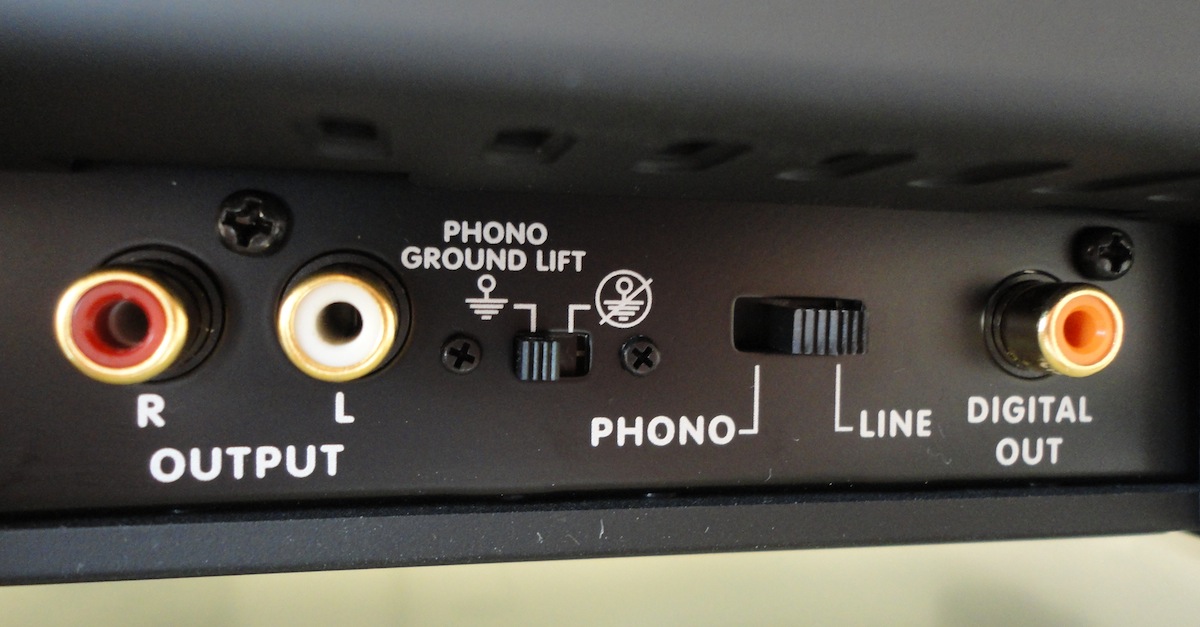
- Switchable line/phono out – Traditionally turntables have a phono (unamplified) output that requires a pre-amp (usually built into the mixer). For Stanton’s turntable to do its digital stuff, though (key lock basically), you need to use the line-outs, which deliver the same volume as those from a CD player would. Hence no need for a pre-amp in your mixer, and also it means you can record from the line out
- A digital out – There is a digital coaxial out for plugging straight into SPDIF digital equipment for recording (eg high-end sound cards, computers)
- Switchable ground – If your mains grounding is good, the 3-wired plug that comes with the STR8.150 can ground the turntable to prevent buzz, without the need for a separate ground. If for whatever reason it isn’t, you can switch to chassis ground – although I couldn’t find a chassis ground pin for a ground lead. Whatever, there was no discernible buzz on the audio output for me in either setting. The flimsy ground lead was notorious for snapping off with Technics – can’t say I miss it
-

Stanton’s 680v3 cartridge is a welcome inclusion with this deck, showing it means business for scratch/DVS DJs, although of course, you can fit any cartridge you choose. A new start/stop top left – As previously mentioned, for turntablists who habitually rotate their turntables 90 degrees counter-clockwise to make scratching easier, there’s now a second start/stop
- The ability to play 78 records – If you’re looking further and further back for your musical sample inspiration, it’s good to know this deck will play 78s just fine (you press 33 and 45 together)
- A pro cartridge and needle – The Technics didn’t come with a cartridge; this does, and with an excellent one too – the Stanton 680v3, one of the most respected cartridges there is. The headshell has a removable 2g weight (saves blu-tacking a half-penny to the top of the deck – hell I’m showing my age here), and so the system is set up for rock-solid scratching out of the box


So what’s it like to use?
This is, funnily enough, going to be the shortest section of this review, because the job of a DJ turntable is actually very simple: high torque, steady pitch and good tracking. Strip away all the frippery and what you want is a motor that holds its speed, a needle that holds the groove no matter what you’re doing to the record, and for the pitch, you set it at to remain where you put it.
The Stanton excels in all areas, equalling or better all competition. The extra torque actually took a little bit of getting used to, but in a good way. Stanton is known for its cartridges and so it’s no surprise that this turntable hugs the vinyl – I can’t fault it there. Sound quality is excellent too through all three outputs (line/phono and digital). Apart from that, there’s really very little to say. It just works – well.
Conclusion
If you just want a turntable for ripping vinyl with, spending this kind of money makes no sense – get a decent belt-drive (Stanton do a couple of good ones themselves). But if you want to add analogue to your set-up for actual DJing, you need a proper direct-drive turntable. For the digital DJ, who may only be adding one turntable to a home studio set-up for sampling or mixing the odd piece of vinyl rather than full vinyl DJ sets, you’re getting the best of both worlds here.
You’re getting a turntable you can practise on (because if you can use one of these you can use a Technics set-up in a DJ booth) but with key lock, digital out and line out controls enabling you to hook it up into your digital set-up in three ways. Add in the non-digital improvements (reverse, start/break adjustment, pitch adjustment up to +/-50%, the ability to play 78s) and it’s a no-brainer.
Likewise, if you’re going down the Serato or Traktor Scratch DVS route, there’s no sense in finding some Technics to buy instead of choosing a more modern turntable like this, as the added flexibility and features are so totally worth having.
The STR8.150 came out in 2005, which as we’ve learned in turntable years, is just about yesterday. Obviously sensing their opportunity with the announcement that the Technics decks have been discontinued, Stanton has stepped up marketing on this product – and with good reason.
Because in short, with the STR8.150 Stanton has future-proofed the turntable. Whether in DJ booths being used for Serato or Traktor Scratch control, or at home to complete an all-media home DJ studio, this turntable takes up where Technics left off. As far as turntables go, the next 30 years could well turn out to be Stanton’s.
Do you own this turntable? Are you looking at buying a digital turntable? Do you think it’s important for digital DJs to be able to DJ on turntables? Let us know your thoughts in the comments below.


Phil Morse

