


The Lowdown
For their size, these are competent little powered monitors. While you wouldn’t want to use them to power a party (you’ll break them, even though their quotes 20W output was painfully loud a fair way before being turned up full), or as your only reference monitors in a studio set-up (not accurate enough), they are a great all-round speaker for DJ practice, computer audio and even small DJ booth monitoring.
Video Review
First Impressions / Setting up
These are a “serious” little speaker; quite traditional in appearance, and heavy for their size. Their price point puts them squarely in the category of speakers for “prosumer” users.
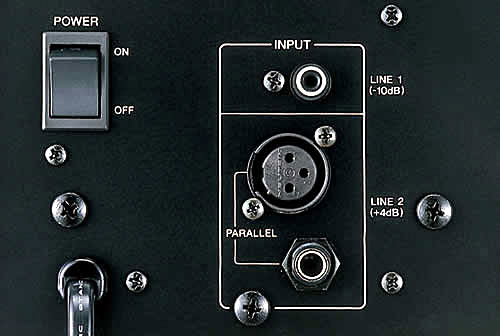
The casing is heavy duty plastic, with a metal plate at the back. The tweeter is protected by a small plastic moulding, and the woofer by an indented black metal grill. There are four controls on the front: low and high (ie bass and treble), and two independent volume controls for the various inputs. There’s also a small green LED at the middle bottom of each monitor to indicate that it’s switched on. Round the back is a power switch, the AC cable (it’s wired in), and three inputs. There’s an RCA unbalanced input (“line 1” on the front), and a choice of XLR or TRS balanced inputs (“line 2” on the front). They would look equally fine in a tiny home studio or sat either side of a computer – which as I said at the start, is where I suspect many people will use them.
They are “powered”, which means that there’s a single amplifier in each speaker, and that means you need to split your output from, say, your DJ controller or mixer into two mono inputs – one for each speaker. This is often achieved by buying a stereo cable and simply pulling the twin leads apart, or of course buying two mono cables to start with.
In Use
I plugged these in to our workshop set-up, which is currently a Rane Sixty-One mixer controlling Serato Scratch Live, and listened to a variety of electronic music on them.
They performed exactly as I expected they would on first listen. There was not a massive amount of bass; however what there was clear, the front porting (the two holes mid-top of the speaker you can see in the pictures) helping with that.
Small speakers don’t deliver the same amount of bass a larger speakers – it’s physics – and if you are lucky enough to practise your DJing in a room where there are no neighbours or family members in adjacent rooms or apartments, you may want to add a sub-woofer too; these are, in fact, pretty ideal as satellite speakers.
The low and high EQs are good to have for adjusting the sound to room characteristics (why do I always want to boost the bass whenever given the choice, though?) – although they don’t boost or kill by a massive amount. Think of them more as “fine tuning” rather than all-out EQs like you find on a DJ mixer. Continued listening revealed a definite step up from other similar-looking but cheaper speakers we’ve tested recently, such as the M-Audio AV40s (a good value little top-end computer monitor speaker). The sound felt “refined”, with crisp, extended highs and no hint of harshness.
Conclusion
For their size, these are competent little powered monitors. While you wouldn’t want to use them to power a party (you’ll break them, even though their quotes 20W output was painfully loud a fair way before being turned up full), or as your only reference monitors in a studio set-up (not accurate enough), they are a great all-round speaker for DJ practice, computer audio and even small DJ booth monitoring.
The three inputs and two line controls on the front mean they’re practical, because you can leave a few sources plugged in and even mix those sources from the front panel – great if you want to plug in your DJ controller, computer’s internal sound and even a third input too all at once. Having an aux in the front like the M-Audio AV40s would have made them even more useful.
Overall, then, you get what you pay for here: they’re a highly useful, professional, well-made little speaker, and they deserve their success over the years. If size matters to you (and we’re talking “as small as possible” here) and you’re not impressed with pseudo-pro computer speakers, take a look at these; within their limitations, they’re a workhouse that won’t let you down.
