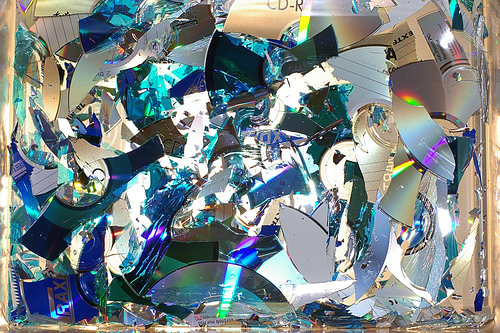
With so many mix CDs now becoming landfill, maybe it's time to stop handing out CDs and start making mash-ups to get DJ bookings. Pic: steffenz
Something curious has happened over the past few years – the DJ mixtape has lost pretty much all of its currency as a tool for DJs to get gigs with. (And by “mixtape” I mean, of course, any kind of DJ mix, be it on CD, SoundCloud, podcast or – gasp – even on tape.)
Even when they do seem to work, and a promoter says “yeah, I’ve listened to your mix, I’ll give you a go”, believe me, 9 times out of 10 he hasn’t. Instead, he’s checked your Facebook following, or booked you because of your drive and professionalism, not your music.
Meanwhile, a newer breed of DJs are propelling themselves from zero to hero, and fast, on the back of mash-ups. Since the mash-up scene exploded globally in 2003 with 2 Many DJs leading the charge, artists have increasingly got DJ bookings on the back of viral mash-ups, produced quickly on computers. (For the sake of this article we’ll include “unofficial remixes” in with mash-ups, too.)
And with mixtapes losing their currency so rapidly, now mash-ups – which at their most simple are the vocal of one song over the instrumental track of another, but which of course can be much more than that – are actually starting to look like as viable way of getting noticed as a DJ as producing mixtapes once was.
Now we’re not saying you should do anything different at all once you get the gig. You’re a DJ, and your DJ sets don’t have to change one bit because of this. But to actually get your foot in the door? Mash-ups are a smart way to go. Get an internet following and you’ll get noticed, and this is one fast way of doing just that.
Don’t believe it? Consider these arguments:
1. Anyone can beatmatch nowadays
The old advice used to be “make a great mixtape, then spread it around”. When Sasha and John Digweed released the first commercially available mixtape, Renaissance: the Mix Collection, back in 1994, it became an instant classic and propelled their careers globally.
You can’t hit “sync” and produce a good mash-up.
But behind them were thousands of DJs who were just glad they could hold mixes together – and they were getting booked on the back of tightly mixed tapes, even though they were mainly just mixing outro beats into intro beats, which is musically, of course, one of the most boring things you can do.
Now, anyone can hit “sync” and produce just such a technically perfect beatmatch. It might not be musically perfect, but it’ll be technically perfect. The cat’s out of the bag. Bog-standard mix tapes don’t cut it any more.
Mash-ups, on the other hand, demonstrate musical and technical skill. You can’t hit “sync” and produce a good mash-up. They can separate the men from the boys in an age when the mixtape no longer can.
2. Long DJ sets never did translate to mixtapes very well
A good DJ is not someone who can work out that “this mixes quite well with that”, or that “this order is roughly good for these records”. A good DJ is someone who can interact with his crowd and follow their cue. A good DJ knows what his crowd wants, and while giving them that, also gives them stuff he knows they’ll like but they don’t know it yet!

Sasha in an all-time classic club shot: How can any DJ mix ever show how good a DJ is at crowd interaction?
All of these skills mean that any DJ set of any length loses some of its magic when recorded, or worse, when produced without a real audience there at all. Half the reason for doing it is absent, either when recording (in the first case), or when listening (in the second). When you got carried away listening to a DJ mix, what do you do? You close your eyes and imagine yourself in a club.
The only “produced” mixes that ever really worked were mainly by people who tellingly also produced much of the music on the mixes themselves, or at least remixed or re-edited it to fit the mix. They were, effectively, making mixes using their own mash-ups all along.
3. Club managers and promoters rarely listen to mixes
I’ll put my hands up here and say I know this because that used to be me. I used to receive sometimes 20 mixtapes a week when I promoted a successful club. I was also a resident DJ, and there’s just no way I could listen to all of those tapes.
Plus, I was well aware of point 2 above – that I wasn’t actually hearing a representation of the skill that really matters in DJing, the “programming music in front of a crowd” skill.
I used to receive sometimes 20 mixtapes a week when I promoted a successful club. There’s just no way I could listen to all of them.
Instead, the mixtapes that stood out were those where the mixing was fast, musical (ie lots of acappellas, basslines under different vocals etc) and often outright mash-ups – Cassette Jam spring to mind. The kind of tapes where mixing and musical skill shone through from the first 30 seconds. Mash-ups, in other words.
By the time John Steventon released his book DJing For Dummies in 2006, he was already advising DJs to make a “transition only” version of their mixes:
“As some club promoters may only care about how you mix from tune to tune, and can get enough of a sense of how you’ve programmed your set by only listening to the highlights, or maybe just don’t care, you can help your cause by including a series of audio tracks that just contain the 30 seconds (approximately) of time spent mixing from one tune to another,” he wrote.
If promoters, managers and club owners don’t have time to listen to a mix, and instead just want to hear the transitions anyway, isn’t the next logical step from doing a “transitions mix” to simply to produce a good mash-up? It might actually get listened to… especially if it has hundreds of thousands of listens on YouTube, which the venue manager notices.
4. Mixtapes can’t easily go viral like mash-ups can
A good mash-up can change your life. Ask DJ Earworm, whose United State of Pop series propelled him from struggling musician to global DJ literally overnight:
“When my 2009 United State of Pop mash-up went viral, via YouTube and Facebook, I literally filled my DJing diary immediately. It was insane – I took just 24 hours to go from nobody to someone everyone wanted to book to play their parties.” he told me.
Posting a mash-up on YouTube that then gets shared across Facebook gives DJs with the musical and technical ability to make them a fast route into international DJing success – Earworm has proved that, but he’s only one of many.
This route is simply not available to mixtape producers. While they can share mixes online, I don’t know of any example where a full-length mixtape has “gone viral” in this way. Armed with a viral mash-up and a name on everyone’s lips because of it, you’re far more likely to be able to get DJing gigs – and to get people coming to them.
Plus it doesn’t have to be hard: “You don’t need a distributor, because your distribution is the internet. You don’t need a record label, because it’s your bedroom, and you don’t need a recording studio, because that’s your computer. You do it all yourself,” says UK mash-up artist Mark Vidler of Go Home Productions.
5. DJ mixtapes have lost their cool
Now don’t scream “that’s not true!” at me – I know in some places, in some scenes, mixtapes are still legal tender. But overall, globally, they’ve long-since lost their shine. They were hammered into the ground by computer-mixed commercial CDs full of tunes that nobody really loved, nobody wanted to put on one CD and that only sold (for a while) because of the marketing budgets put behind them by major labels and long-irrelevant superclub brands.
Now, everyone’s a crate digger and everyone has the capability to incorporate a mix at one BPM or find a bunch of obscurities from the Internet”
(I have a friend who used to mix such CDs throughout the 90s for a nameless major label, who remembers it as one of the most artificial, soulless things he did in his music career.)
“Now, everyone’s a crate digger and everyone has the capability to incorporate a mix at one BPM or find a bunch of obscurities from the Internet,” wrote Ari Stein in a recent Electronic Beats Online article.
“There have been no real genre innovations since Richie Hawtin used 100 tracks and 300 loops to create his 53-minute ‘Closer to the Edit’ mix in 2001 or since 2 Many DJs started their bootleg series around 2003.”
So if anyone can make a mixtape nowadays, and they’re seen as a throwaway, bankrupt medium, unless yours is truly exceptional, it just isn’t going to stand out from the crowd enough to do you any real favours.
Maybe that explains why for every mixtape we get sent on Twitter or by email here at Digital DJ Tips from our readers, we get at least two or three mash-ups.
There’s still a place for mixtapes…
Of course, there’s still room for mixtapes. It’s vitally important for DJs to record their own mixes, to take the time to make disciplined mixtapes – and they can still gain gigs and get a lot of pleasure from them. Even more importantly, it’s still a fantastic idea to record your live sets – that’s where the real skills are.

London club Fabric's long-running CD series has garnered critical acclaim by maintaining the quality and pushing boundaries.
And because a few good clubs still use mixtapes to showcase their sound (I’m thinking of Fabric is particular here), and a handful of labels allow DJs to produce mixtapes with real skill and flair (!K7′s DJ Kicks series springs to mind), mixtapes still have place.
But remember, the best mixes from these sources are highly produced things – a far cry from the old-fashioned DJ promo mix.
So while there’s still room for mixtapes, I think they’re no longer really much use for getting gigs – indeed, they haven’t been for a while now.
Instead, smart new DJs have realised that the best way to get gigs is to produce your own music, get a radio following, or to promote your own club night (in order to DJ as resident).
To that list, we can now add making a killer mash-up.
• Our full interview with DJ Earworm will appear on Digital DJ Tips soon.
What do you think the best way to get decent gigs as a DJ is? Have you had success getting booked through mash-ups? Have you used any of the other methods we mentioned above to get booked? Would you like to make mash-ups but don’t know where to start? Let us know your thoughts in the comments.
Now go to:
How To Make And Perform Mashups
The Definitive Guide To Making a Mixtape
7 Easy Steps Towards Your First DJ Booking
Look! How To Digital DJ Fast - Video Course
From Digital DJ Tips, four hours of online video to get you from beginner to first gig in just four weeks. Join the 1000s of DJs who've already benefited from this training. Click here!
Learn to DJ Free - email course plus bonus PDF book
Sign up for our weekly email course for beginners now...
Trouble choosing a controller? Get your free 162-page guide!
Grab "DJ Controllers: The Ultimate Buyer's Guide" at our Facebook Page.
Come and meet other DJs just like you!
The long-awaited Digital DJ Tips forums are now open. Come and chat!


“You don’t need a distributor, because your distribution is the internet.”
Not true. I’m external music director at a college radio station, and I DO NOT scour youtube and soundcloud and everywhere else looking for new music. I talk to a distributor/publicity company and get the music they are promoting. There are exeptions (you email me personaly and introduce yourself, or send a physical CD), and each DJ will play whatever they want to, but dont take stuff like that for granted.
As to labels, you can be independant and very successful, but it still takes lots of hard work.
[ link ]That’s another debate though, David. what we’re talking about here is getting a popular viral mash-up to use as a lever to get gigs – nothing more.
[ link ]Gotta say, I disagree. I’m a up and coming wannabe Peter Schickle and I rely on Soundcloud, Weloveyoursongs, and 8tracks to fill my music based show. Promoters don’t help me ’cause I’m not “mainstream”. It’s all about new stuff for me.
[ link ]Fair enough, we’re talking, however, to the majority of our DJs who play house/electro, pop and hiphop.
[ link ]I like the article and the topic…but I think that names like Earworm, 2ManyDJs, and others like Girl Talk are a few successes in a massive world of “terrible”.
I see mashups and homemade remixes all over the place…and I’m not dissing people who do them…but by listening you can tell who is trying to grow musically and who’s just going through the motions in the hopes it gets them DJ gigs.
I see DJ web sites with guys posting loads of what they call “remixes” or “mashups”…all Soundcloud players…and many aren’t very imaginative or interesting. I see many that’s just the original track with an added beat or even a few effects tossed in. It becomes a lot of quantity without much quality…and the DJ is simply bragging how he’s produced loads of tracks. I think eventually the “producer” thing is going to get judged by who’s on SoundCloud and who’s on Beatport.
“Oh…you got tracks on SoundCloud? How about Beatport? No? Then why should I book you over the other 1000 amateurs telling me they have tracks on SoundCloud?”
Finally…my only bigger grudge with mashup culture is that in many ways I feel like we’re not moving forward musically. I’ve heard a FEW very talented mashup acts and a good number of well-produced mashup tracks. However, I see many more guys who throw down sets of music that makes rooms happy, then brag how they’re playing totally new and exclusive music.
YET…when you listen, it’s all just old pop hits with new beats on them. In my book, you can play some homemade remix of Bon Jovi, but it’s not driving the music forward because all the crowd hears and adheres to is Bon Jovi. You could play the original tune and it wouldn’t make any difference to the crowd. The real superstars of mashups are taking pieces of old hits, but they’re toying with them to such a degree that they become new.
In the end it’s still a popularity contest. If you make mashups and have nobody listening/downloading while the guy next door makes mixtapes and gets thousands of downloads every day…then the mixtape guy is going to get booked.
In terms of the DJ, I would read this article and tell them they should be investing not just in tracks, but loops, sounds, and accapellas. Even exploring those new tracks for pieces to use…then bring them to the show in more than just straight mixing. Sync is out there, but it’s not perfect. I still see programming and creativity as what wins fans…unless you get on a reality show or date a celebrity.
[ link ]Very valid points. It must be about music and quality But the thing is, people can vote with their feet – if a mashup sucks, it won’t get the views/shares on social media. The best mixtapes take a lot of time and effort, and for a mashup to succeed, the same thing applies. the point of the article is that a mash-up might nowadays be the best way for a talented DJ to show off his skills, because a good one ought to get recognition online in a way a mixtape can’t, and als that maybe in this age of the best DJs being technically, socially (ie ability to read a crowd) and musically aware, mash-ups are the best way to demonstrate this mix of sensibilities.
[ link ]Agreed.
[ link ]ok…..so clubs dont listen to mix tapes:
1)a mix tape is not just some random mix off the fly-REAL dj’s put time and effort into putting the compostition of a mistape together and is quite often genre specific for this reason.
2) mashups in general: and this could cause an arguement
……the shit that is getting promoted at this moment in time as “dance music” is an insult to what dance music really is: house, lounge, old school even hard dance etc: “electronic dance music” is a mutated form of what real HOUSE MUSIC (and all its subgenres created). This was formed on the soul, passion love of real music that once was (and still is
) but now is diluted by this mainstream dirtwater (traitors including guetta, the swedes etc etc as well as squirrelex and other assholes)….what happened to the love of real music???
stuff that is so easy to use should not be put into the hands of trolls and allowed to “produce” noise which is what the vast majority of mashups actually are. What happened to the skill of musicians?? this EDM shit is far from what the real dance music scene is all about.
[ link ]We didn’t say don’t make mixtapes, we said they’re not going to get you booked nowadays.
[ link ]Making a mashup is like one level before actually producing. It gets your name out there because people post your mashup online, novice dj’s use it, and in the end you’re getting exposure for mashing up two songs. Mashups, in itself, can be very elaborate or real simple. It all comes down to the execution of the mashup.
[ link ]i frequently do this on my sets.. looping a song on a deck while continuously playing the other song on the 2nd deck, or sometimes i play an a-Capella on the other.. i agree that the crowd react more on this kind of mixing because they hear something new…
i think earworm got this in the bag, for me his the best mash up DJ
[ link ]I’m preparing an extended review of the Traktor S4 at the moment and am really looking forward to exploring how that may help in the actual performing of mash-ups. I think many mash-up artists are happiest to DK with Ableton Live because that’s what they make their mash-ups on as it makes sense, but I suspect there is a lot of mileage in the sample decks on Traktor S4 too.
[ link ]i was thinking of ableton too.. my friend uses that for his mash ups
[ link ]I’ve actually been doing this for a while now, and I’ve seen that I stand out from other DJs that just play dance music. I agree, it takes more than hitting the sync button to make a decent mashup.
[ link ]Great article once again! I’ve been thinking about getting more involved with the music. Which programs would you recommend? I know Afrojack uses FL Studio, but outside of that I don’t know of any programs that are used.
Thanks!
[ link ]Ableton Live is interesting, because you can perform on it as well…
[ link ]Maverick Remix – Fabolous & Patwa – You Be Killin em – http://snd.sc/ebqj0Q LISTEN NOW
[ link ]well that does it then, i was thinking of knocking up a bootleg mash up next week, now its defo on the to do list. I’ll let you all know how successful it is…great article, right on the money…investing in sounds rather than just music and using the available tools to live mash up and remix rather than just play is the only way forward for dj’s who want to stand out. Plus it is much more interesting for me as a dj to watch and listen to when out clubbing, and brings back the sense of wonder and amazement from 15 years ago of how the dj managed to do what they did… sync is a great tool, but if its all you use and creativity doesn’t replace it, whats the point?
[ link ]looking forward to seeing the s4 reviewed fully as well
I’ve been doing mashups basically since i started (about a year ago) most of the following are done on the S4. I’ve found mashups more fun than just mixing from one song to another.
[ link ]I Agree. Valid points. Interesting article to read. Thanks for posting this, Phil. I will be looking forward to your interview with DJ Earworm.
[ link ]You make alot of valid points…one problem I see is when you talk about youtube being the platform for DJs to showcase their mashups…The fact is that youtube is a video platform and without a great video to go along with a great mashup then the whole thing is rather ineffective. DJ Earworm’s United State of Pop also had a great video mashup as well. Not to mention like others have before, creating a good mashup is very difficult and getting a good mashup recognized in a sea of crap may be even more difficult.
[ link ]That’s true but you do’t need a particularly good video – plenty of tunes have blown up without a great video. We have news of a really interesting new way for artists to make videos for their songs, too, coming very soon…
[ link ]this may seem like a stupid question, but what is the difference between a “bootleg,” a “mashup” and a “rework”? i’ve seen these words used in what seems like interchangeable ways – bootleg and mashup in particular. what’s the difference?
[ link ]Bootleg and mashup? No difference. A rework is usually an unauthorised remix of one song rather than two or more songs mashed up.
[ link ]Hi Phil – interesting article.
I, however, have never considered a bootleg and mash up the same. A mash up (a combination of 2 or more tunes) is a bootleg but a bootleg, in my understanding, is any unauthorised/unofficial remix of a tune be it a mash up or a straight remix.
A rework is just another word for a remix.
I wait to be corrected.
[ link ]I think “bootleg” is used more in Europe to mean mash-up, and certainly in Balearic circles, “rework” has an unauthorised connotation.
[ link ]The sync button has brought the DJ scene to new lows. There’s too many cooks in the kitchen. Now any monkey can be a “DJ”, so its no longer about how good you are at bringing new and exciting music to the crowds. Its no longer about breaking new ground. Now its all about how well you can mash together a bunch of the latest pop chart hits (coz lets face it, nobody’s going to get a million billion Youtube views mashing up the latest obscure Epic Jamaican Hardcore Afro Trance tunes), or how many Facebook fans you’ve got. If you want to make any headway as a DJ now, you’ve got to sell out.
David Guetta is a prime example. Prior to his One Love album, he was relatively unknown outside of Europe. Suddenly One Love shot him to worldwide fame, and his singles have dominated charts the world over since. Why? Because he has chart topping pop artists perform his vocals.
If you took to the streets a few years ago and dropped the name Chase & Status, not many outside the Drum and Bass scene, and even fewer outside of the EDM scene would know what you were on about. But since they’ve started producing that commercialised brand of Dubstep thats become the lastest fad, almost anybody who listens to Radio 1 would know who they are.
[ link ]Truth in what you say but I disagree with sync being the culprit for DJ culture downfall. As an Ableton DJ I see warping as an opportunity to get more creative with looping, effects, 4-6 simultaneous tracks playing, etc.
The absence of beat-macthing as a pre-requisite should be standard understanding to incorporate other skills, not kick back.
[ link ]I was a club DJ, before I started making mashups, and I have to agree I could never have got the bookings I have without the following I have built up through mashups.
Making a mashup, especially one that will be popular is not as easy as whacking an acapella over any given track. It really is production. You have to work with the structure of an instrumental and compliment it. Propelling it along as almost a new track that people will have ‘memories’ of.
If your not musically trained, don’t understand musical key/chords, forget it – you won’t succeed. But get it right and I guarantee you’ll build a bigger following in a year than you would in five years as a DJ alone.
One thing that was missed was just how easy it is to get introduced to record labels when you are a mashup producer. People think because of the legality of it all, that record labels will not talk to mashup makers, but that’s totally wrong.
The vast amount of DJ’s are wannabe or bedroom producers, this is a great way (so long as you can do it well) of getting people knocking on your door.
Last thing, are normal club DJ’s aware that mashup DJ’s (by that I mean ones that can perform live) get paid much more than the going rate, and we often only do a two hour set!
[ link ]Not totally true – depends what you’re trying to do. Obviously musical training helps if you want to do a multi-mash like Earworms, but Ableton helps with that too, and also using small short drops like he does or Madeon did with that live mix also helps.
But rave times proved you don’t need to be that musical in mashups – the best ones for me are fun or funny, and a lot of times they aren’t actually technically that good – but they push a button, or are topical, or just make you laugh or are a combination that no-one has thought of. It’s as much in the idea as much as the technical production – I wish more people worked on their idea as much as their conveyor belt production of recent popular pella of the day vs old tune(s).
What bores me more with mashups is the ones described above that are perfectly done but don’t really add anything to the genre – they might have matched all the 50′s progression songs they can find seamlessly – but it just seems like a desperate blatant ‘look at me!’ attempt to get radio play and DJ play pushing all the ‘classic’ cheese buttons like Bon Jovi and Van Halen & 80′s synth pop hooks et al – Girl Talk is worst at this from a musical standpoint but a lot of people do basically medleys that sound too much like Stars on 45 or Jive Bunny to me.
Really for me the genius of mashups is the WTF factor – either it’s ludicrous, funny, punk attitude treating the sources with total contempt or humour. Or very rarely it’s producing a seamless AvsB which is very hard with something everyone knows but in a way that no-one’s done before (Stroke of Genie-us for example) which sounds like a released tune which changes the game. Multimashes can be brilliant (Earworm & Loo & Placido for example) but sometimes they devolve into a sort of ‘remember this?’ ADD nostalgia vamping, unless you have a new slant on them, like Madeon’s live mix. Also the cheese factor unless approached funnily can get very wearing, like too much candy will make you sick.
Tim (Radio Clash / DJNoNo / Instamatic)
[ link ]BTW the post I was referring to ‘above’ was D-Jam’s not Dylan’s!
[ link ]Good points. Was thinking about that the other day – should mashups always necessarily be “ironic”? Or if someone who didn’t know either record heard the mashup, should it stand on its own two feet separate from the originals?
[ link ]I would agree with 99% of this. Truth is, the standard DJ skills, once valued, are now being automated by software capabilities. And in all honesty, club crowds dont want you to beat juggle and screw up their memory of top 40 tracks, which is why the mashup has become so important, familiar & fresh at the same time.
I am very much a victim of this phenomenon, after one of my mashes showed up here: http://freshnewtracks.com/2011/04/17/avicii-afrojack-britney-spears-katy-perry-and-ludacris-mashup-monday/
I received quite a few emails from out of state college representatives wanting to book me and fly me out for a performance.
What I will say the 1% differential is this. As much as you might think a technical mashup can be executed by beat sync, it’s definitely not so simple. Not to praise my own art of mashup or anything because truly, it’s mostly being lucky and only 10-30% talent, but (and i know this is a long thought) there are mashup techniques that are only available in softwares like ableton that allow the DJ, or mashup artist to transform tracks. Some of the tracks I mash are half original mix half remix, edited acapellas, sidechain compressed and pumping. These are all production-based elements that your standard DJ doesn’t know, without having some producer background.
SO in short, anyone can take a G6 acapella and spin it over a hard dance track, it’s a lot more difficult to make things work, and understand the mixing/production techniques necessary to fit two tracks.
I generally spend 2-4 hours on a mashup and never less than an hour for sure.
Website:www.3lau.bandcamp.com
[ link ]Sooo, I just finished my first ever mashup, after being a DJ for 4 years and been into remixing for at least a year n half I don’t know why I haven’t tried this sooner!
http://soundcloud.com/edwilder/arcade-fire-vs-afrojack-we
Hope some of you like it!
:: Ed
[ link ]Sounds really good, Ed, you should be proud of it.
[ link ]Much appreciated! Thanks for taking a listen
[ link ]Hello. I really Enjoy your articles on DJing, i come to digitaldjtips all the time if i need some tips and i recommend it to all the dj’s i have connected with. I do alot of mixes but i find it really hard to do mashups, do you have an article on digitaldjtips about creating mashups, i can’t find any good articles on the internet about mashups.
[ link ]Here you go: http://www.digitaldjtips.com/2011/04/how-to-make-and-perform-mashups-part-1-sampling/
[ link ]How funny! Lastnight I was going the Ambient songs setting cue points. Bored as hell and needing a kick I turned on Battleflag and randomly found Fu Schnickens and started beat matching. After 20 minutes of fun I recorded it just for the helluvit and liked it so much it’s on Mixcloud today. One take. Mashups are hella fun and I’m glad I found this article! Can’t wait tonsee what I pull off when I’m really trying. Lol
[ link ]I have to say I think this is a bit ridiculous. So outside of live performances the DJ has no reason to mix? They should just save the mixing for the clubs and only produce mash ups when at home or in the studio? Don’t get me wrong I think a huge part of being a DJ lies in their ability to produce and create a track but I feel like this article is trying to belittle the art of mixing (which can be bland or can be amazing, depending on the mix). I hear demos from DJs which are 8-13 min ‘mashups’ which are actually a standard DJ mix (done terribly and sloppily) which are flooding the market as much as the DJ mixes you hate. I actually listen to mixes, demos etc. If I am busy I will skip to where the next track mixes in and listen to the transition (its not that hard people, it does not take a tremendous amount of energy). I would rather have a good DJ who knows how to mix than a DJ who thinks that mixing 3 tracks in a 15min set is a ‘mash up’. Really I think the form of ‘mashups’ is killing EDM right now, because instead of people trying to create new music and actually learning to produce, they would rather take deadmau5 stems and toss an acapella on top and call it a mashup. So now the crowd is happy because they can hear a porter robinson beat with a brittney spears acapella – but what about music with real merits, outside of the mainstream. There are DJs who are known for doing amazing mixes based on quality of the content, not how amazed we are to hear a pop vocal on top of an overdone beat (Lee Burridge, Steve Lawler, etc.). Maybe I listen to different music than you guys but honestly the term ‘mash up’ usually refers to ‘bad electro, dirty dutch mix with rap vocals on top’ in my circles. Maybe Im a DJ for the music, not because I want to become a pop icon or be on american radio.
[ link ]Hi! What you mention has been done for 20 years (I remember DJs putting house vocals over Gat Decor’s “Passion” and calling it a mash up) and is absolutely not what I mean here. Nobody is amazed to hear a pop vocal over an overdone beat. Demonstrating musicality in a world where the stakes for DJs are now higher than beatmatching is not the same as “wanting to be a pop icon or on American radio”.
[ link ]I agree with you while simultaneously understanding the point of getting attention as mentioned in the article.
I pride myself in unique track selection and seamless mixing (“undetectable” or seamless).
As it’s said though, “Where there’s a will, there’s a way”. Our style won’t be going anywhere anyhow, I guess it’s an issue of separating yourself from the herd.
[ link ]No one listens to mix tapes anymore… Yeah because everyone think they are a DJ these days.. Not fair that people had to learn the skill of mixing on vinyls or cds just for people to use a Pc & a sync button nowadays.
[ link ]That’s where we are, Blake. What are YOU doing that makes you stand out from the wannabes TODAY?
[ link ]What’s the point in stating that “it’s not fair”? What exactly is “not fair” about it? I suppose you should also think that automatic transmissions are “not fair”, or that email is disrespectful to all the poor souls that had to learn how to write letters by hand and use stamps. In both these cases, the person that learned the skills that the technology now automates are actually at an advantage.
If you know how to manually beatmatch, you should be a better DJ for it, not a bitter DJ for it.
[ link ]