


The Lowdown
This is Mackie’s full battery-powered PA in its biggest configuration: two Thump Go tops sitting on two ThumpSub Go subs, all running off swappable batteries with no wall socket in sight. The tops have been around a few years and we liked them, but the subs are what’s new here, and they’re among the first proper battery-powered subwoofers from a big-name brand. At roughly $2,100 for the two-plus-two setup I tested, you’re not paying for anything you couldn’t get from a normal small PA on sound alone – you’re paying for the freedom to set the whole thing up anywhere. On that front, it delivers.
Video Review
First Impressions / Setting up
I’ve had the tops for years – we reviewed them back when they launched – but this was really my first proper go with the complete system, new subs included. If you don’t know the Thump Go tops, they’re small, light and easy to carry, the kind of wedge speaker you can throw on the floor as a monitor, stand up as a DJ booth speaker, or pole-mount as a main. They’re a classic little battery-powered top, and there are plenty others like them. The subs are the interesting bit.
Each sub has two 8-inch drivers and its own carry handle on the side, and I could hump them in and out of places without much fuss. They include poles, which is nice. They look good in the usual Mackie way, with a solid grille, the little dancing-man logo, and a couple of LEDs on the front to tell you when it’s on and when it’s charging. You can stand them upright to save floor space, though you have to lay them flat if you want to screw a pole into the top to mount a speaker above.
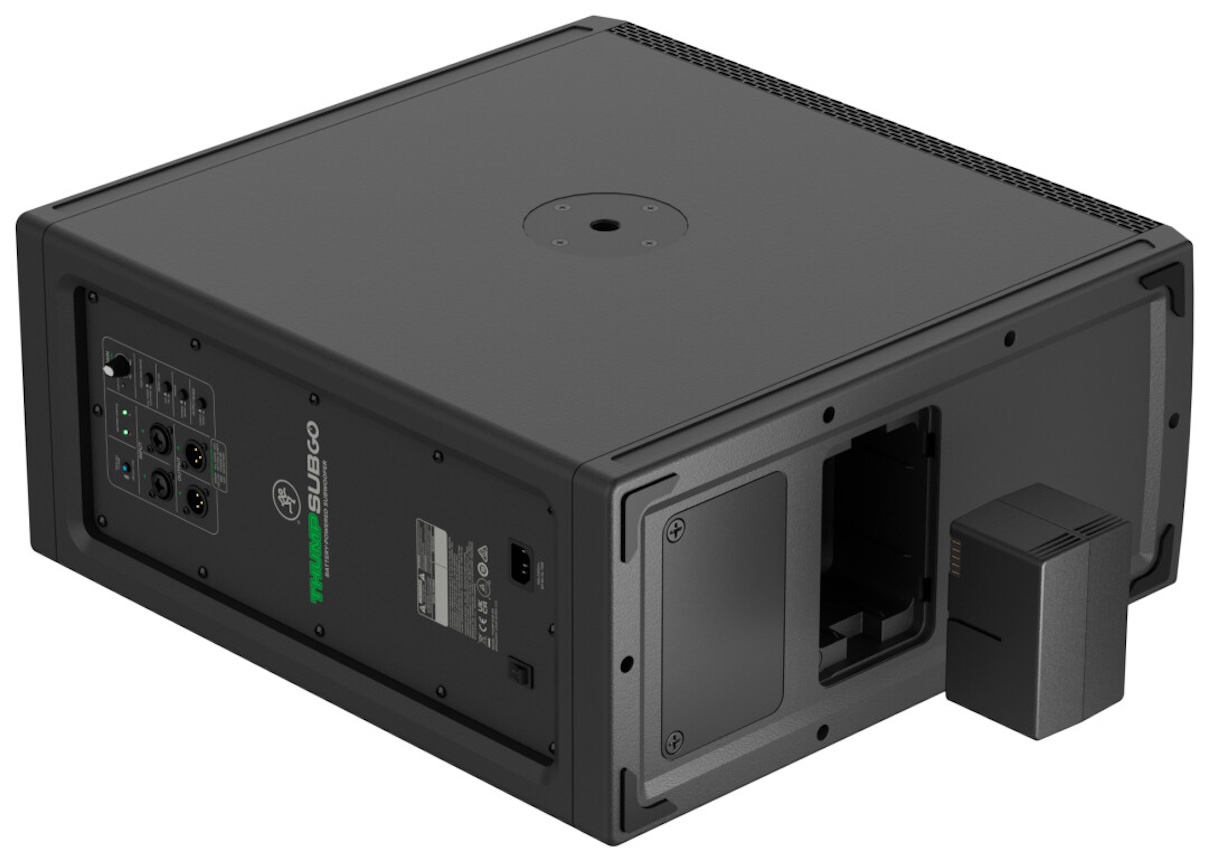
The battery system is the star, and it works really well. Each sub takes two batteries in two compartments, and they’re easy to drop in and swap out. The tops use the smaller GB-100 battery; the subs use the bigger GB-200. I had one battery in each sub for testing, which gives you around six hours a side, and you’d add a second battery per sub to hit the 12 hours Mackie quotes. Budget for these extra.
Round the back of the sub you get the usual inputs and outputs, a Bluetooth pairing and button, a main output volume, and switches for stereo/mono, full range/high pass, the front LED, and phase. That phase switch is worth playing with if things ever sound thin – speakers can end up out of phase with each other purely because of where they’re placed, and a flip of that switch often sorts it. As a reminder, our review of the tops is here.
In Use
Think of this as a standard, classic small PA system – two tops, two subs – that Mackie has done a very good job of putting batteries into. It’s not designed to power a 500-person rave, and it doesn’t pretend to be. For 50 people outdoors, or maybe up to 100 indoors, the whole system will do you nicely.
Once I got music playing, the subs did exactly what you’d hope. When the bassline kicked in you could immediately tell they were there – two subs a few feet away are always going to sound good, but this did sound properly nice, the kind of low end you feel as a thrill. I had no business playing music that loud in a residential area, which is why I stopped fairly quickly in the video, but they’re absolutely up to the job. It sounds exactly as you’d expect from a PA this size, and I mean that as a compliment – nothing surprising, nothing disappointing, just a solid, full sound.
Designed as a pair
The subs are designed to work with these specific tops. You can pair the sub with any speaker you like up to a 10-inch woofer, but the crossover behaviour is dialled in for the Thump Go tops, so that’s the combination that works best out of the box.
The voicing modes on the tops are the thing to get right if you’re running (any) subs. Set them to sub mode and the tops handle the mids and highs only. On their own you’d leave the tops in music mode. There’s also an outdoor mode that lifts the high frequencies a touch to compensate for the lack of reflections outside. Music ducking and the feedback eliminator are really singer-songwriter features aimed at the mic input, and I can’t see many DJs using them – you’d use the mic input on your DJ gear instead – but they’re there if you want them.
Background Bluetooth limitation
The one real limitation I ran into is around Bluetooth routing, and it’s worth explaining. You can pair Bluetooth to a top, and you can link two tops together wirelessly. But once subs are in the chain it gets awkward: if you feed the tops from the subs via cable, the tops won’t pass on a Bluetooth signal, so Mackie’s advice is to pair Bluetooth straight to the sub and let it feed the tops. That works for one sub and its tops, but I couldn’t find a clean way to get Bluetooth across a pair of subs and a pair of tops without running a cable between the two halves. There’s a switch in the app that looks like it should solve this, but it didn’t for me.
It doesn’t matter much of course – Bluetooth is fine for playing background music through the system, and that’s really all I’d use it for. For actual DJing, Bluetooth is useless anyway because of the latency; you’d never mix over a wireless connection. So while it would have been nice to see a tidy solution, in practice you’ll plug your DJ gear in properly and this becomes a non-issue.
App gives options
The app is worth getting. It gives you a bit more control, though the onboard EQ is only two bands, so don’t expect to sculpt a room in any detail. The batteries, as I said, are the best-implemented part of the whole thing. The ability to swap a battery mid-set without the sound dropping is definitely useful for a long wedding or an all-day event, and it’s the sort of thing that separates this from just strapping a power bank to a normal speaker.
Build quality is what you’d expect from Mackie at this end of the range – solid grilles, decent handles, nothing that felt flimsy in the time I had them. The subs in particular feel like they’ll take being lugged around, which is the whole point of a system like this.

Conclusion
What you’re buying here isn’t better sound than a comparable mains-powered small PA – it’s the convenience of a system that runs entirely on battery, and on that score Mackie has nailed it. The subs kick out plenty of bass, the tops are the same likeable little speakers they’ve always been, and the battery system across the whole rig is the best part of the package.
If you DJ outdoors, on the beach, at barbecues, or anywhere you could run power but would rather not, this genuinely has your back. It’s also great for filling a space with sound, for presentations, and for smaller events – and I’m thinking wedding and mobile DJs will find a lot to like.
At around $2,100 for the two tops and two subs I tested it’s good value. I’d budget for a spare battery per sub to get the full runtime, which pushes the cost up a little. If you don’t need the full stereo-with-subs setup, a single top and single sub covers a lot of gigs for far less.
This is a competent, classic small PA that happens to be the most sorted battery implementation I’ve come across, and you’re paying for the freedom to play anywhere rather than for anything you’ll hear in the sound.
