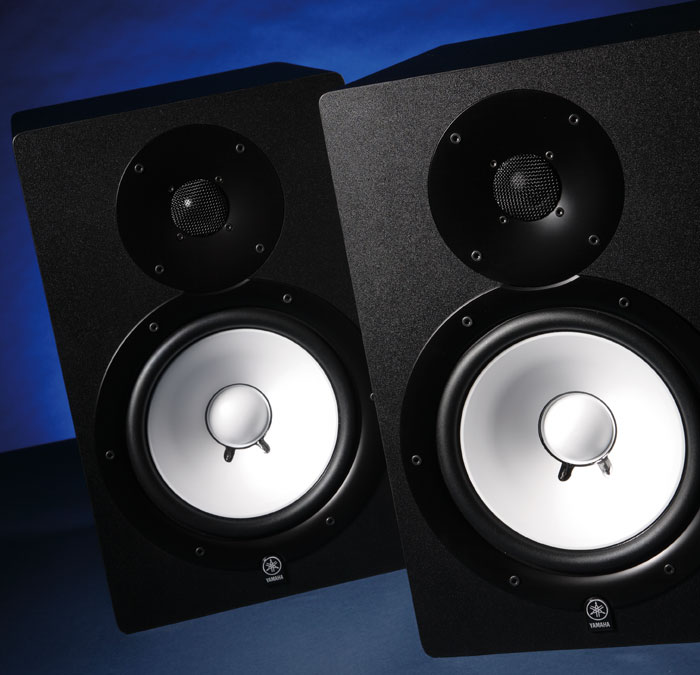
Decent monitor speakers, properly set up in a suitable room, will elevate your mixing and your recordings way above those produced on poorly bought, badly set up gear. In this three-part series we'll show you all the secrets to getting this crucial part of your home studio right.
Before you were a DJ, you probably didn’t care too much about speakers. If you bought a computer, a TV, a home cinema system, a games console, you probably ended up with speakers that came with one of your pieces of gear, which you just plugged everything else into and, well, just used.
But it’s not quite so simple when you want speakers for DJ use at home. Because not only do you need to be sure that your recorded DJ mixes are going to sound exactly as you want them when played in your fans’ cars, in promoters’ offices, on other DJs’ MP3 players and so on, but unless you get your home monitoring right, you’ll find it harder to produce great DJ mixes in the first place.
So in this brand-new three-part series, we’re going to look at the three things you absolutely need to get right in your home monitoring system: Choosing great speakers in the first place, setting them up correctly, and getting the room acoustics as ideal as possible where you practise. This week in part one, we’ll look at speaker selection.
How to select the right DJ monitors
Let’s get some terminology out of the way first: “DJ monitors” (or just “monitors” – there’s no real difference) are speakers. Same thing. There can be two types: those with built in amplifiers (“powered” or “active” monitors), and those that need a separate amplifier (“passive” monitors).
The music you DJ will determine to an extent the speakers you go for.
The music you DJ will determine to an extent the speakers you go for. If you play bass-heavy dance music, size and volume count more than if you’re a 60s wedding DJ, for instance.
But also you need to consider the practicalities; if you DJ in a shared room or a small apartment, there is going to be a limit to the size and volume you can get away with!
Listen before you buy
If possible, listen first by going to a dealer. Sound is a very subjective thing, and it’s important to trust your ears on this. Take a mix or track you know very well, and ask yourself:
- Does the bass sound tight and controlled, or boomy and muddy? – DJing is often all about bass. Make sure you can hear it properly on the speakers you’re considering
- How good is the stereo field? – Can you tell the different elements of the tracks apart? Producers often “place” different elements in different places by altering their position in the stereo mix. Being able to hear elements apart is often crucial for accurate beatmatching
- What characteristics do the high frequencies have? – You’re going to be listening to these for an awful long time, and often at relatively high volume. Do the high freqencies sound crisp and clear, or harsh and shrill?
- How engaging is the sound? – Or to put it another way, are you hearing things you’ve never heard before in that familiar material you’re testing them on? If so, it is a positive thing

The M-Audio BX10 has a footswitch so you can easily see what your mix sounds like with or without it.
Subwoofer or not?
Some purists will tell you you don’t need a subwoofer (a subwoofer is a big, extra bass speaker that due to the frequencies involved is unidirectional, so you only need one of them). Good monitors should give you all the bass you need, they’ll argue.
Thing is, with many listeners nowaday using subwoofers (and we’re not just talking subwoofers in cars and rich peoples’ hi-fi systems either; many gaming speakers nowadays also have them), you really could do with knowing what your mixes sound like on them.
As long as you integrate your subwoofer properly, it can extend the bottom end of your sound without disturbing or upsetting the rest of the mix.
It’s not essential to buy a subwoofer, especially at first – but it’s definitely worth considering. You can always add one later if funds are tight…
Next week…
Today we considered what to look for in DJ monitors. Next week we’ll look at how to set them up properly, and in the third and final part, we’ll look at room acoustics.
Are you ready to buy your first set of proper DJ monitors? Are you lucky enough to have a decent store nearby to audition them at, or will you be relying on reviews and internet opinion? Please share your thoughts in the comments.
Now go to:
A Beginner DJ’s Guide To Monitors, Part 2: Positioning Your Speakers
Review & Video: Yamaha MSP3 Active Monitor Speakers
Review & Video: KRK Rokit 6 Powered Monitor Speakers
Want to escape the bedroom and play in public - fast?
Our 1000s-selling How To Digital DJ Fast video course shows you how.
Learn to DJ Free - email course plus bonus PDF book
Sign up for our weekly email course for beginners now...
Trouble choosing a controller? Visit the web's #1 guide!
DJ Controllers: The Ultimate Buyer’s Guide 2013.
Tags: beginner digital dj tips, dj monitors, dj speakers, studio monitors
This work is licensed under a Creative Commons Attribution-NonCommercial-NoDerivs 3.0 Unported License.

Hey Phil,
I wanted to take the “To sub or not to sub” argument to the next level. So if I decide not to get a Sub woofer , what should I get as monitors? Is it beneficial to the overall bass to get a speaker with a bigger cone?
I’ve heard good things about the new Behringer monitors and I’m considering picking one up. But should I get the small cone version ( 5″ inch I believe ) or the big cone version? ( 8″ inch )
But then again.. I’ve seen the behritone 10″ sub woofer from behringer for 100 euro’s. The difference in price between the two sets of monitors would be about that amount.
Hard choices!
[ link ]That’s why I say you must listen first. Only your ears can answer this stuff for you.
[ link ]I just set up a club with new speakers and while I didn’t use nylon audio bounce triangles nor a flat mic with a pink noise generator and a spectrum analyzer, the place sounds good. New professional powered speakers are a lot better than they used to be. I attribute this to the audio engineers doing a better job of designing speakers to present better (so there’s less need to do an EQ for the room) and matching the speakers so that each speaker cone better covers discrete ranges instead of overlapping them (which gives that bloated, too much presence over some of the range but not enough in others in the sound envelope).
If you’re buying speakers for Musical Public Address (A.K.A. Bands and DJing) you want to get Subwoofers. Not only do they extend the range of the sound in the half-space (through the floor and walls near the speaker), but you get more low-end immersion (which has the effect of the audience feeling engulfed in music rather than just surrounded by it) in addition to the boom.
I always suggest going a little larger than you need for the space because the speakers won’t have to work as hard under normal circumstances (giving longer life) and they can give that *bit extra* in special circumstances.
Pro Tip: Adjust the bass as the room fills up with people, more bass for more people and vice-versa. People absorb sound and in order to maintain a good, clean bass with good immersion, be attentive to the crowd size.
[ link ]Thanks for your feedback! Although to be clear, in this series we’re talking exclusively about setting up a practice area at home, not about PA systems or public speakers.
[ link ]Fair enough, however the reason you have monitors at your studio that you hear what your audio should sound like in public. If you’re really going for true fidelity, you should EQ the environment with pink noise and a spectrum analyzer. Most of the people I know think that proper EQing sounds wrong to them, yet they complain about ear ring and lack of engagement in the music.
[ link ]Unfortunately doing to much EQ to a system (with pink noise and a test mike as input) isn’t the be-all to end-all. The preferred method to get your monitor system (or more accurately your listening space) to sound neutral is to adapt the acoustics (ceiling, walls, speakerplacement, flooring, windows/drapes, basstraps, etx.).Furthermore for most (home)studio listening rooms the rule of thumb is that +/- 6dB deviation from straight is acceptable. And NOTHING in the real world sounds totally neutral. And then there is the way your ears perceive sound. Where a microphone just records the level of information (sound) it picks up at any given frequency, our ears tell us some frequencies SOUND louder (or less so) than others even if the level is identical.
In my opinion, tuning a room solely with an EQ is not the best way. Measuring is good. Taking acoustical measures is good (i.e. damping if there is a lot of natural reverb, or repositioning speakers if you encounter nasty standing waves in a room).
I generally use the EQ only to eliminate the most disturbing and audible disturbances in a room, and with as little EQ as I can get away with.
Since every room you will play in (or your music will be played in) will have a different acoustical signature, it is Utopia to think you can set up your listening/practice room so it sounds like what your customers/audience will hear eventually.
So for listening room/practice room you can aim for acurate results by tuning the room acoustically (be aware of some major costs if you are unlucky!) so you can get the balance between all the frequencies/instruments in your mix/musix as right as possible.
Get an audiogram done as well. You’d be surprised (especially if you have been DJ-ing for a while) how much some parts of your hearing have deteriorated. Which means you might not hear enough high frequencies for example so you’ll end up turning up the high frequency EQ too much to compensate). Somebody with “good” ears will perceive your music/mix as having too much high frequencies as a result.
Room acoustics is a (high end) science, and getting it just right can be very time consuming and expensive, plus not everybody lives in a situation where they can radically alter their (bed)room just for sounds sake. I think that if you have a monitoring set up that makes a reference CD of your favorite artist that you have heard on several systems sound good and feel good, you have reached a practical goal.
Don’t overanalyze, let your ears and feeling do much of the talking.
Good speakers help, subwoofers will help give that extra information that (especially smaller conus) monitors lack in the low end of the frequency spectrum.
. So your mix on a home systems might just sound slightly different on a club system
.
Mind you, no “home” subwoofer will give you the amount of depth or “oomph” that 4x 18″ subs on 2x3kWatt digital amps will give you
Phil says he’ll get around to stuff like speaker placement and room acoustics in the next chapters so let’s see what he comes up with.
Greetinx,
[ link ]Chuck “DJ Vintage” van Eekelen
Appreciate the high-end discussion chaps!
I am sure you guys know this site by now – we’re practical and pragmatic, and we offer simple solutions that’ll work for 80% of DJs, 80% of the time. There are always lengths that you can go to past this, but for most of our readership, they’re not going to be practical for time, expertise, monetary or space reasons. We’re not about perfection, just getting it done and learning as you go along.
Actually, this is the bit that I liked best here: “Get an audiogram done as well. You’d be surprised (especially if you have been DJ-ing for a while) how much some parts of your hearing have deteriorated. Which means you might not hear enough high frequencies for example so you’ll end up turning up the high frequency EQ too much to compensate). Somebody with “good” ears will perceive your music/mix as having too much high frequencies as a result.”
This is I think one of the most neglected points when it comes to accurate monitoring, and I haven’t mentioned it at all, so thanks for bring it up, Chuck.
[ link ]I may have the definitions down wrong, but from what I’ve learned so far from various hifi enthusiasts etc is that monitors are specifically for “monitoring” in a more production kinda sense. As in when you are talking about how a subwoofer could make sense to check out how your stuff sounds on a system like that, that would be listening for reference but has nothing to do with “monitoring”, because it’s bound to mess up your production (your monitors sound bass heavy thus your production will be lacking in bass on other systems, for instance). In an ideal world you would have monitors which are strictly for playing back music as NEUTRAL as possible.
But of course as you say, people tend to have limited space / resources and thus it might be necessary for some to do it all with one pair of speakers / one system.
-
I personally have a big ass hifi which I use to enjoy my music and also use for reference, but I will get some neutral monitors (in the strictest sense of the word) for production, even though I only deal with EDM in that department.
-
And one last note: Since we are talking about beginners, maybe/often set up in their bedroom, not having much space it’s very likely they will put the speakers on their desks together with the rest of their kit. Not all monitors will provide good sound in such a setup, because there are speakers specifically for CLOSE RANGE monitoring. And since they are available across all price ranges, that should DEFINITELY be noted in the article, otherwise people will be pissed off, when their expensive speakers sound like crap sitting one meter away from them.
Thanks for the good article, it’s definitely a useful addition to the amazing stuff on digitaldjtips.com
[ link ]Thanks for your feedback! I agree that sub-woofers CAN if used incorrectly mess up the sound overall, but as the series transpires, you’ll see we’ve been careful to ensure they get set up properly. They only show you what’s already in the sound, so they don’t have to mess up reference at all – the sound is no less true with a sub-woofer in place. Plus some have a footpedal so you can easily turn them on/off for comparison (as we’ll see).
DJ monitoring is in effect “monitoring lite” – so is related enough to production monitoring to broadly need the same type of things considered, even though we don’t have to be so anal about it as DJs (because the music’s already been produced and mastered, hopefully well).
And regarding close-range / medium range monitoring, all but the biggest monitor speakers are close-range anyway.
[ link ]I would be surprised to see a well made neutral subwoofer plus speakers in the price range of a typical “Beginner” ^^
But yeah, hifi guys definitely have the tendency to become very anal when it comes to that stuff, and it’s not necessary here as you’ve mentioned. Looking forward to the next one of the series!
[ link ]I was actually referring to producers, who clearly need to be anal about it as transparent sound is crucial when actually making music. Thanks again for the feedback .)
[ link ]I think it’s a common misconception that subwoofers are there to make the bass louder.
In a club enviroment i can understand why they’d get used that way, but in a hifi- or production system their only purpose should be to extend the frequency range, taking over where the capabilities of the stereo speakers end, usually somwhere between 40-60 Hz for typical hifi speakers. Don’t believe the advertising crap about that small wooden box giving you 20-30000 Hz (although some *very* big monsters might be able to pull that off).
If pure volume is your biggest concern, i’d simply suggest you invest into bigger speakers instead of a subwoofer. And they’re likely to get you a better bass response, too.
So if you set up your system, you should try to achieve a more or less flat frequency response that smoothly extends the one of your main speakers.
If you can’t hear much difference with certain genres of music, then that’s just the way it’s supposed to work. For example most rock albums won’t have much sound below ~50 Hz on them (and if they do, it’s often just noise). But with really bass-heavy music it can make a huge difference.
Apart from your main speakers and the genres you spin, you should also consider the size of your room. Very deep bass needs a lot of room to spread properly and the bigger your room, the louder and deeper the bass can get. If you’re in a small bedroom i think it’s pure illusion that a subwoofer will help that much if your speakers already give you a solid bass.
[ link ]Thanks. You put it better than I did
[ link ]I built my own set of reference monitors, for $200 sounds just as crisp and tight as a pair of $400 speakers that I demo’d at at various “DJ” audio stores
[ link ]Good work!
[ link ]I bought KRK Rockit 6 speakers for djing and home studio and i’m very happy of them but not my neighbors…
[ link ]Every time i do a mix because of the bass which is too loud and i have to put the bass to -10 db min and it’s hard to adjust, otherwise i use a second mixer.
It’s much better than old my computer speakers which were very confuse in the middle range when 2 songs were together.
I advice to buy this type of monitor because it’s very powerful ever and it changed my way to mix, i use them both as return when i have the chance to do parties for my friends
LOL,
I can see how a pair of Rokits would sound better than your computer speakers did.
[ link ]I have the BA1031a 8inch Monitors. They slap and sound great both for practicing and for production.
[ link ]http://www.behringer.com/Es/Products/B1031A.aspx
[ link ]Wharfedale Diamond 7.2 anniversary edition with Onkyo 100 watts amp and a subwoofer 100 watts, play EDM but sometime I do private latin parties (salsa,merengue etc) no complain in practice section with this.
[ link ]Genelec 8030A. Can’t beat ‘em, and will last a lifetime.
[ link ]Very interested in getting monitors speakers. Iam looking for 8 inch only. I just dont know what to choose since you guys have not a reviewed the mackie MR8MK2. I liked when you guys put two products two the test together. It would be great to see an article called “KRK RPG8G2 VS Mackie MR8MK2″. You can find both of these 8 inch speakers bundled with stands, xlr, rca, and trs cables on amazon for 500$(and yes, they are pairs).
So which one should i get!?………. But hey the Pioneer SDJ08 are 688$
[ link ]Let me put it to you this way… HELP ME OUT WITH A GOOD ARTICLE HERE
Hi,
I own a set of KRK Rokit 5″ monitors and I like them a lot. At the show in Frankfurt I had a chance to try the VXT series 8″ and I was mighty impressed, nice clear, transparant sound, plenty of power and with amazing low end performance for 8 inch speakers. So, you might want to add them to your list to “try before you buy”.
Greetinx,
[ link ]Chuck DJ Vintage” van Eekelen
Forget to check the prices on the KRK’s before opening my big mouth :-p … they may be slightly above budget there.
You can find them here (Holland) for about 499 euro, each
.
A pair of VXT 6′s come in at 760,00 or so.
Oh well … too much choice (as with most of this stuff)
Greetinx,
[ link ]C.
My pleasure as always
[ link ]heavy discussion around hear. I agree with the rokit owners that posted before. I got some old “hifi system” from the GDR before I bought my rokits.
Since I bought them I learned my choons properly…i can hear anything and its great.
Dunno if a subwoofer would mess up this clear sound especially if u prefer darkstep and technoid dnb like I do ….
[ link ]Iam highly satisfied with my rokits…
I can hear anything. I think a subwoofer wouldnt fit for me and would mess up the crystalclear sound. Especially if u prefer to listen to and mix darkstep and technoid dnb as I do……
)
Subwoofer in my car was the best investigation since I bought my rokits for geoworks though
Regards from Germany
Soundcloud.com/m0kcast
[ link ]Best purchase I ever made were my Microlab SOLO1Cs. 50 quid. That’s it. And they are powerful, active monitors that sound amazing. For a DJ starting out, like me (=]), they are invaluable. And the best part is, the range scales up, to the mahoosive 7Cs, which would be perfect for most house parties.
So yeah. Speakers can be had cheap!
[ link ]Ear protection is very important and there are some very good ‘in ear’ monitor solutions too.
[ link ]I wont go into to much detail just putting it out there that especially where loudness is an issue this could be a viable solution.
If you are a dj and not a producer you dont need a perfect linear frequence response to do nice mixes.
In fact, you probably like a speaker with more crisp and thump better and it most likely going to be cheaper too.
I use Yamaha’s “Stagepas 300″, 8″ woofer and 1″ hf driver that gives you that “PA” sound and I can bring them as monitors on gigs.
If you listen to Genelec speakers at home, the sound is not going to be the same in a club-system, built to break thru 95dB of backround noise.
[ link ]Yes, I agree, that’s why it’s not so mission critical for DJs as producers, which I’m trying to get across in this series.
[ link ]I agree with the one who said that the mix should be neutral for recording purposes. at the end of the day, every system sounds different in different rooms. right? so its down to the owner/operator of the sound system to adjust its settings to optimize a certain song in a certain room with the system in hand according to their own needs.
i remember for example certain songs having too much bass which was really unnecessary. bad recording i thought, because to avoid distortion i had to turn the volume right down,say in the car or kill a lot of the bass on the eq with the console.
So yes the recording should sound as neutral as possible so i dont see the need of a sub for recording purposes. for practicing or to enjoy practicing more then yes definitely. im no expert but everyone is entitled to their opinion i suppose
[ link ]