Returning DJs make the same five mistakes in their first month back, every single time. After 15 years of teaching DJs at Digital DJ Tips – and watching tens of thousands of comeback DJs work their way back to the decks – I see the same patterns repeat. Two of these mistakes are about the gear and the music. One is about getting overwhelmed by what’s changed. And two are mindset traps that have nothing to do with the kit at all.
Here are all five, and exactly how to avoid each one.
- Obsessing over the gear
- Drowning in music library complexity
- Getting overwhelmed by features
- Feeling out of date
- Not realising how much DJing has exploded
What gear should I buy to start DJing again?
Don’t agonise over what to buy. One or two simple pieces of kit do everything you need: speakers, headphones, possibly a new laptop, and a DJ controller. Buy something basic to start. If you stick with it, you’ll want to upgrade anyway – and once you’re back playing, you’ll actually know what to upgrade to.
You need three or four things. Speakers. Headphones. Maybe a laptop (any modern Mac or Windows machine will do, so don’t overthink this). And some DJ gear.
For the DJ gear itself, two starting points cover the ground neatly.
If you don’t want a laptop in the picture at all, look at something like the Numark Mixstream Pro Go. It’s a standalone all-in-one with a built-in screen, built-in speakers and a built-in battery. The inputs and outputs you’d want are all there. Plug it in, load some music, play. If you do want to DJ from a laptop, the Pioneer DJ DDJ-FLX4 is the obvious choice, and the one I recommend to or students day in, day out. It works with Rekordbox, Serato, VirtualDJ and djay, so whichever software you settle on, the controller doesn’t lock you in.
Either way: stop researching, start playing!
Sign up to our newsletter
 Free every Tuesday
Your weekly digest of the latest training, gear reviews, industry news, and exclusive tips and tricks to help you stay ahead in your DJing.
We collect, use and protect your data in accordance with our Privacy Policy.
How do I build a music library after years of vinyl?
Don’t try to rebuild your old vinyl collection digitally, and don’t worry about gathering thousands of tracks. Pick one source – a download store, a subscription pool, or a streaming service compatible with your DJ software – and find 30 tracks you love. That is your first proper set. Everything else can come later.
Downloading, ripping, streaming, organising – this is the part that feels nothing like vinyl, and it’s the part that traps people. Returning DJs spend weeks researching where to get music and how to manage it, before they’ve even mixed two tracks together.
The fix is simple. One source, 30 tracks, today. Once you’re mixing again, the rest of the library question takes care of itself. You’ll naturally work out where to source the music you actually want, what software to organise it in, and how to manage it.
Do I need to learn every button on modern DJ gear?
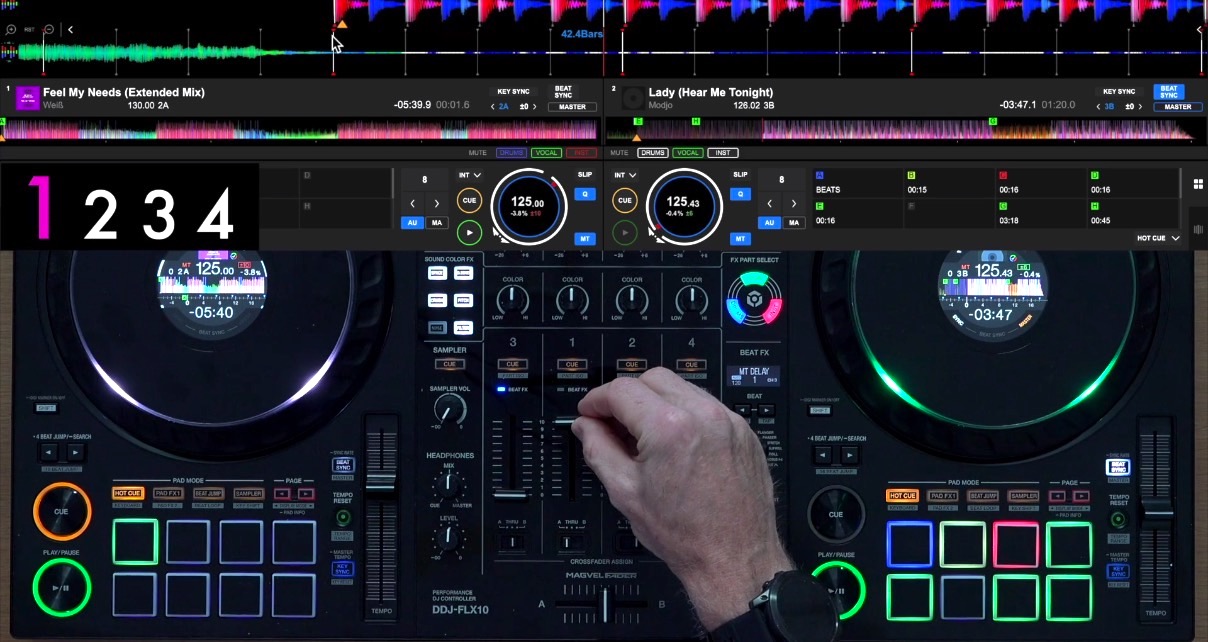
No. Modern controllers have dozens, sometimes hundreds, of buttons, and you can ignore almost all of them in your first month. Just do what you used to do on vinyl: cue, beatmatch, mix. Loops, hot cues, effects and sync all come later. In the first month, the music matters more than the mixing.
Even the most basic modern gear has features that will be unfamiliar to a returning DJ, and the bigger controllers can look intimidating at first. The trick is to ignore them.
Every piece of DJ gear made in the last 20 years has the same core controls on it: play/pause, pitch, EQ, channel faders, crossfader. Those are the controls you used on vinyl too, in essence. Use those. Mix tunes together. Get your ear back.
The fancy stuff – loops, hot cues, FX, sync – is brilliant once you’re ready for it, and we teach all of it in our training. But teaching yourself stacks of new techniques on top of getting back into mixing is how comeback DJs burn out. Mix first, decorate later.
Is my old music taste still relevant?
Yes. Your music knowledge and your record collection are your strength, not your weakness. Today’s younger DJs respect those who were there back in the day. If you can find 20 or 200 people who love the music you love, you have an audience, and the rest of the room will come along for the ride.
This is the mindset mistake I see most often. Returning DJs assume their taste is out of date and that today’s crowd wants something else. It’s wrong on both counts.
Depth of knowledge in any genre is rare and valuable now. The DJs being booked for interesting parties, doing the well-followed online shows, and putting out the most-listened-to mixes are not the ones playing the current chart. They are the ones with a perspective. Yours is decades deep. That is the asset.
Where can I DJ today?
Almost anywhere. Clubs and festivals are still going, but DJing now happens in much smaller venues too: bars, restaurants, cafes, weddings, private parties. Today’s gear is small enough to fit anywhere. And online DJing is now a real thing: Mixcloud, SoundCloud, Twitch livestreams. You can find your audience without leaving the house.
Returning DJs often picture the same scene they left – a club, two decks, a mixer, a Friday night. Of course that scene still exists – but it may longer be right for you. DJing is much bigger than the club nowadays, and your audience probably isn’t clubbing any more, either.
Luckily, the gear has shrunk, and so has the threshold for setting up a DJ in a room. A single all-in-one unit fits behind a bar. A small controller fits in a backpack. Venues that would never have hired a DJ 20 years ago are now hiring them weekly.
Online is the bigger shift. You can record mixes for Mixcloud, livestream on Twitch, build a SoundCloud following from your spare room. None of this existed when most returning DJs last played, and all of it is open to you the moment you get a setup running.
So how do I get back into DJing the right way?
If you’re nodding along to all of this, the training I’m about to mention was built for you.
There are two sensible routes from here. The first is our Complete DJ Course, the quickest way to get back up to speed without the trial and error. Gear, music, mixing, all in one place, no fluff. Skip the year of working it out alone.
The second is our All Access Pass. This is for the returning DJ who already knows they’re back for good and wants the full toolbox: every course we’ve ever made, every course we’ll ever make, plus the community and the platform behind it. It’s an education partner for the rest of your DJ journey, not a one-off purchase.
One gets you mixing again. The other is for life. Whichever fits.

Phil Morse